

Most people have undefined wants.
Not because they lack intelligence or ambition — but because defining what you actually want is uncomfortable work. It requires decisions. Decisions require commitment. Commitment closes options. And keeping options open feels, in the short term, like a kind of freedom.
It isn’t. Undefined wants don’t produce freedom. They produce drift — the quiet, painless condition of moving through life without direction, busy without being progressive, occupied without being oriented. The feeling people describe as being lost isn’t usually dramatic. It’s just vagueness, accumulated over time.
Clarity is the direct result of getting exact. Exact about who you want to be. Exact about what you’re building. Exact about what you’ll accept and what you won’t. Exact about how you want to spend a Tuesday. The more precisely you can define what you want across the areas of your life, the more your decisions, your time, and your energy naturally align behind it.
Clarity is not a feeling you stumble into. It’s something you design.
What Gets in the Way
The default mode for most people is reactive. Life comes at them and they respond. Time passes and they fill it. Without any deliberate counterforce, years can go by this way.
A few things cut through reliably: owning your clarity as a personal responsibility rather than waiting for it to arrive. Removing habits and environments that actively cloud your thinking. Committing to one direction at a time instead of scattering energy across too many competing pulls. And acting before you’re certain — because clarity almost always comes from engaging with territory rather than studying it at a distance.
These practices work. But they’re individual moves, not a system. What produces consistent clarity over time isn’t a collection of good habits. It’s architecture.
The Life Folder
Here is an idea. Not borrowed from a book, not a framework someone else packaged and sold. Something you build yourself, from scratch, calibrated entirely to your actual life.
A folder — a collection of documents, each one doing a specific job. Some you read daily. Some you update monthly. Some you open once a year. Together they form an operating manual for your own existence.
Think of how software works. A serious project doesn’t run on a single file. It has configuration files, helper files, modules for different functions, protocols for different situations. Each component has a defined role. Together they make something that actually runs.
Your life deserves the same architecture.
Most people navigate their entire existence without a single written document they designed themselves. They might keep a journal, but journaling without structure tends to process emotion rather than produce direction. They might follow someone else’s framework or buy a planner designed for a generic version of a person. None of that is the same as building your own.
This is common sense made explicit. A meal plan is common sense. A weekly schedule is common sense. Written standards for what you want in a relationship are common sense. Most people don’t have these things written down because no one told them to build them and the default is to figure it out each day from scratch. The folder is simply the collection of things that, if you sat down and thought clearly about your life, you’d obviously want to have defined.

The Manifesto and Mission
The first document answers two questions most people never formally address: who am I, and what am I doing here?
The manifesto is a description of the person you are committed to being. Your values. How you show up. What you stand for and what you refuse. Written in the present tense, as if already true — not as aspiration but as declaration.
Alongside it, the mission: what are you building? Not just your character but your work in the world. What is the project of your life, stated specifically enough that you would recognize it if you arrived?
Leaving these questions undefined doesn’t make them disappear. It means you’re living someone else’s answers by default — shaped by whatever expectations and habits accumulated around you before you started paying attention.
This is the document you read every day. Not as affirmation. As calibration — a return to your own center before the day starts pulling.
The Life Timeline
A timeline of your life — ideally on a larger format, A3 or a double spread — with 100 years laid out horizontally. That’s the full canvas. Mark where you are now. Behind you: what has happened. In front: what remains.
Categories run vertically across the spread. Work and career. Relationships. Health. Creative work. Financial milestones. Major world events as backdrop. The result is a single view of your entire existence — past and projected future, across every dimension that counts.
This document makes the scale of your life tangible. Seeing yourself at 35 or 45 or 55 on a 100-year canvas isn’t morbid. It’s clarifying. You have more time than anxiety suggests and less than complacency assumes. The years ahead are real, finite, and yours to design.
It’s also a confrontation with the shape of your story so far. Where have the peaks been? What happened across different areas simultaneously? Seeing your own biography as a visual timeline rather than as a memory changes how you understand it — and how seriously you take what comes next.
The Ruleset
No one wants to make the same mistake twice. Most people make them several times because the lesson was never formally captured.
The ruleset is a written list of personal rules — things you have decided, not as vague intentions but as actual commitments. What you won’t do. What you’ve tried and found corrosive. What you know about yourself that needs a guardrail.
Some of it is protection from the outside: no tabloids, no passive television, no environments that consistently drain you. Some of it is protection from yourself — compulsive behaviors, patterns that feel fine in the moment and hollow afterward, reflexes that belong to an older version of you.
Written rules work differently than remembered intentions. When a rule is written, the decision has already been made. In the moment of temptation you’re not deliberating — you’re checking against a standard you set in a clearer moment. That shift is significant.
The Standards
If the ruleset defines what you’re protecting yourself from, the standards define what you’re selecting for.
This is where you write down what good looks like across the areas of your life. In work — what kind of environment, what income level, what does excellent actually mean to you. In lifestyle — the baseline below which things feel off.
And for those who are single or navigating relationships: define the person you actually want. Not as fantasy but as a considered, honest description — temperament, values, how they live, whether they have children or want them, how they spend their time. Include what actually matters to you even if it seems specific.
Most people enter relationships driven by attraction and circumstance, without ever having defined what a genuinely good match looks like for them. Written standards don’t eliminate attraction — they give it a framework. When you know what you’re looking for, decisions become less compulsive and easier to evaluate honestly.
Standards prevent drift in every area. Without them it’s easy to accept slightly less than what you want — repeatedly — until the accumulation of small compromises has moved you far from where you intended to be.
The Week Design
The week is the right unit of life design. A day is too short to see patterns. A month is too long to feel in control. The week is the cell — small enough to execute with precision, large enough to contain real work, real rest, real relationships.
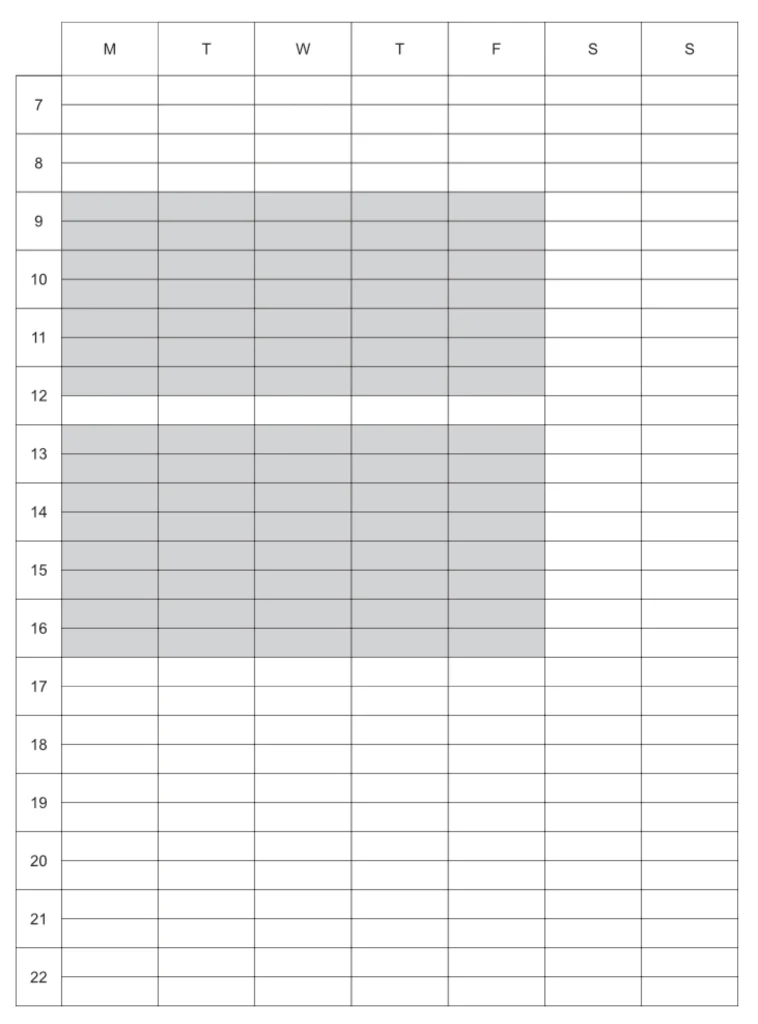
Design the week well and repeat it with intelligent iteration. That’s not a productivity system. That’s how a life actually gets built.
The week design maps the architecture of your ideal week. When you do deep work. When you train. When you connect with people who matter. When you have unstructured time. When you plan and review. The major categories of your life, given their proper place before anything else fills the calendar.
Most people’s weeks happen to them. The week design inverts that. It gets iterated — what works this month may need adjustment next — but the iteration is deliberate. You’re refining a design, not just reacting to circumstances.
The Meal Plan and Food Infrastructure
A pre-designed meal structure, with a companion grocery list or standard stock to maintain, removes a hundred small daily decisions and keeps energy and physical foundation consistent.
Understanding what you’re actually eating is a basic life skill — not complicated, learned once and applied indefinitely. Protein, carbohydrates, fat: what each does, what your targets are based on your bodyweight and goals, how to read what you’re consuming. Any macro calculator or AI tool can walk you through the calculation in an afternoon. Once you have a working nutritional framework, the meal plan and grocery structure flow naturally from it — you’re building around real targets rather than guessing.
Meal prep, where possible, takes this further. The version of you that arrives home tired on a Wednesday didn’t design the meal in that moment. An earlier, clearer version did.
The Fitness and Conditioning Plan
A structural approach to your physical condition — with defined goals, standards to maintain, and a clear enough plan that you know what you’re doing and why.
The framework is simple: three elements balanced across the week — aerobic conditioning, strength training, and mobility and stretching. Missing any one of them creates an imbalance that shows up eventually. Together they cover everything the body needs to stay functional, capable, and resilient. Three to four sessions a week covering all three is enough.
Simplicity is the point. The best program is the one you actually do consistently — which means it has to be enjoyable enough to sustain. Environment matters: a gym you like, training outside when possible, music, whatever makes it feel like something you choose rather than endure. Physical conditioning is hygiene. It doesn’t need to be complicated to work.
The Financial Table
A table with months as columns — at least a full year forward — and income and expense categories as rows. At the top of each column: the opening balance, carried forward from the previous month. Each column calculates what’s in the bank by month end.
This is not a budget in the abstract sense. It’s a rolling cashflow picture. You can see March’s surplus, see that it covers the April trip, see what June looks like after a slow month. Money in motion through time, not money frozen at a moment.
The table functions as a decision simulator. Add a loan repayment as a row and watch what it does to six months of closing balances. Move a vacation from April to September and see the difference. Target a higher income figure and watch the year shift. It signals when to push harder on earnings, when to postpone an expense, whether taking on debt makes sense given what the months ahead actually look like.
Most people make financial decisions from a vague sense of whether things feel okay. This replaces that feeling with numbers in sequence — and the decision gets made before you’re in the moment of making it.
The Travel and Acquisition List
Pinned to the financial table rather than floating as daydream: places you want to go and things you want to acquire, with rough costs and rough timelines attached.
The distinction between a wish and a plan is specificity. When a trip has a cost estimate and a projected date it stops being a fantasy and becomes something you can fund and schedule. The financial table shows you when it becomes reachable.
The Emotional Protocols
Almost nobody has a written response to their own emotional states. When anger arrives, or sadness, or confusion — most people get swept in and react from inside the emotion, which is exactly when reaction is least reliable.
A protocol is a set of steps you wrote in a clear moment, to follow in an unclear one. When I’m angry, I do this before I respond. When I’m confused, I do this before I decide. When I’m low, I reach for this rather than that. Simple, specific, yours.
The version of you that wrote the protocol is the one you want making the decision. The protocol is how you make sure that version shows up.
The Existential Paper
A single page showing the galaxy — the vast sweep of it — then the solar system, then the Earth, then a map of a city. The zoom-out. The pale blue dot.
You are a human being on a small planet orbiting an ordinary star in one of hundreds of billions of galaxies, in a universe whose nature nobody fully understands. Everyone around you is navigating the same strange situation with their own particular programming, their own priorities, their own version of what a life should be.
This is not cause for despair. It’s cause for lightness. The entire life folder — the manifesto, the goals, the financial table, the week design — all of it matters, and all of it is also happening at a scale that makes the anxiety about it slightly absurd. You can pursue your work with full commitment and zero existential grip. Both things are true simultaneously.
Pin it somewhere visible. Look at it when the other documents start to feel heavy.
The Helper Files
The folder grows to contain whatever your life actually requires. An annual health checklist — screenings and appointments to review each year. A car maintenance schedule. A curated collection of quotes that consistently bring you back to yourself. A reading list tied to where you’re going. Any recurring area of life that deserves a page gets one.
Each of these is a small thing. Together they close the gap between intention and follow-through across the real logistics of a functioning life.
How It Works
The folder is not something you build and file away. It’s something you return to — daily for the core documents, weekly for the design and tracker, occasionally for the rest.
A daily read of the manifesto takes two minutes. The week design keeps you oriented. The progress tracker shows you honestly whether what you’re doing matches what you said you wanted. When you’re on track, the reading confirms it. When you’ve drifted — and everyone drifts — it shows you exactly where and gives you something specific to return to. Not a vague feeling that things need to change. A defined standard, waiting for you to come back to it.
Beyond the documents, the environment itself can be designed to reinforce clarity passively. The manifesto printed and on the wall. The existential paper where you see it each morning. A specific sound or light setting that signals a mode shift. Phone automations that surface the right document at the right moment. If drift happens passively — and it does — the counter has to be partly passive too. Visual cues and environmental anchors work even when you’re not being deliberate. That’s the point of them.
There is also something genuinely exciting about building this. Not the discipline aspect — the design aspect. Your life treated as a project. The folder as its architecture. The week as a prototype you’re iterating. The standards as a specification you’re refining. The financial table as a simulation you’re running forward. People invest enormous creative energy in business projects and creative work — the same intelligence applied to your own existence produces something equally absorbing, and the stakes are considerably higher.
This is what it means to define what you want. Not as an exercise in self-improvement. As an act of authorship.
For the foundation beneath all of this — the twelve domains a good life is actually built across — The Complete Picture of a Good Life covers that territory directly. The folder is the architecture. That article is the blueprint. Between them, the picture is complete.