

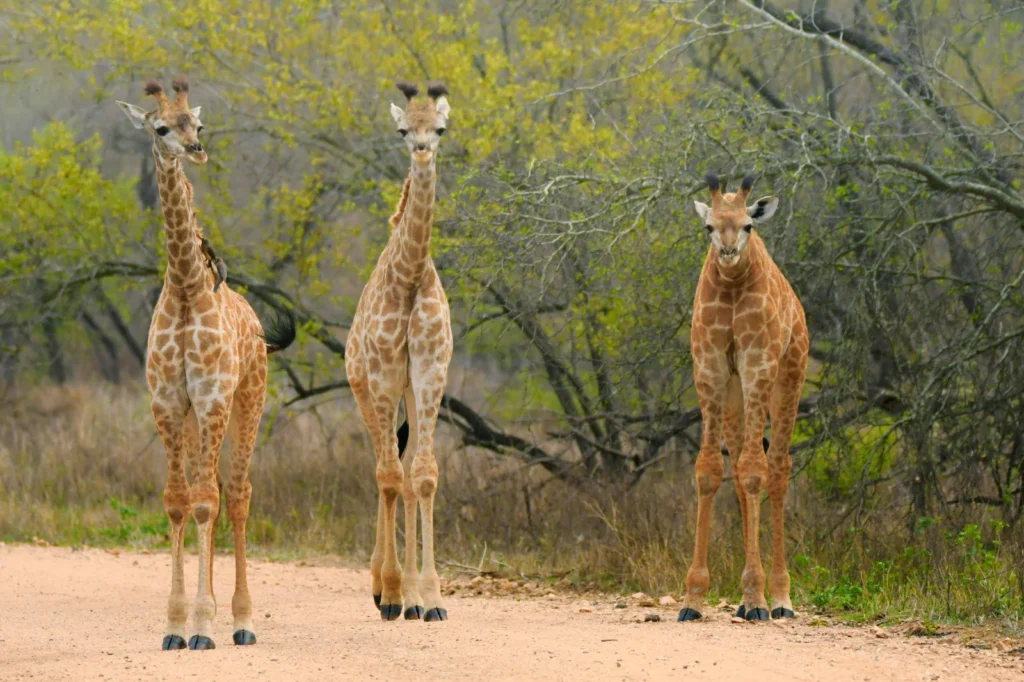
Consider the giraffe for a moment. Really look at it. That neck. Those proportions. The whole creature seems almost too strange to be accidental — like something designed by someone who was clearly having fun with the rules.
The Giraffe isn’t the only one—the Rhinoceros feels just as improbable, only heavier.
It’s like whoever designed the world spent extra time in the “creative creatures” department—just experimenting for fun. The Giraffe looks like someone said “what if we just kept adding neck?” and the Rhinoceros feels like the reply was “cool, now make it angry, armored, and slightly confused about it.”
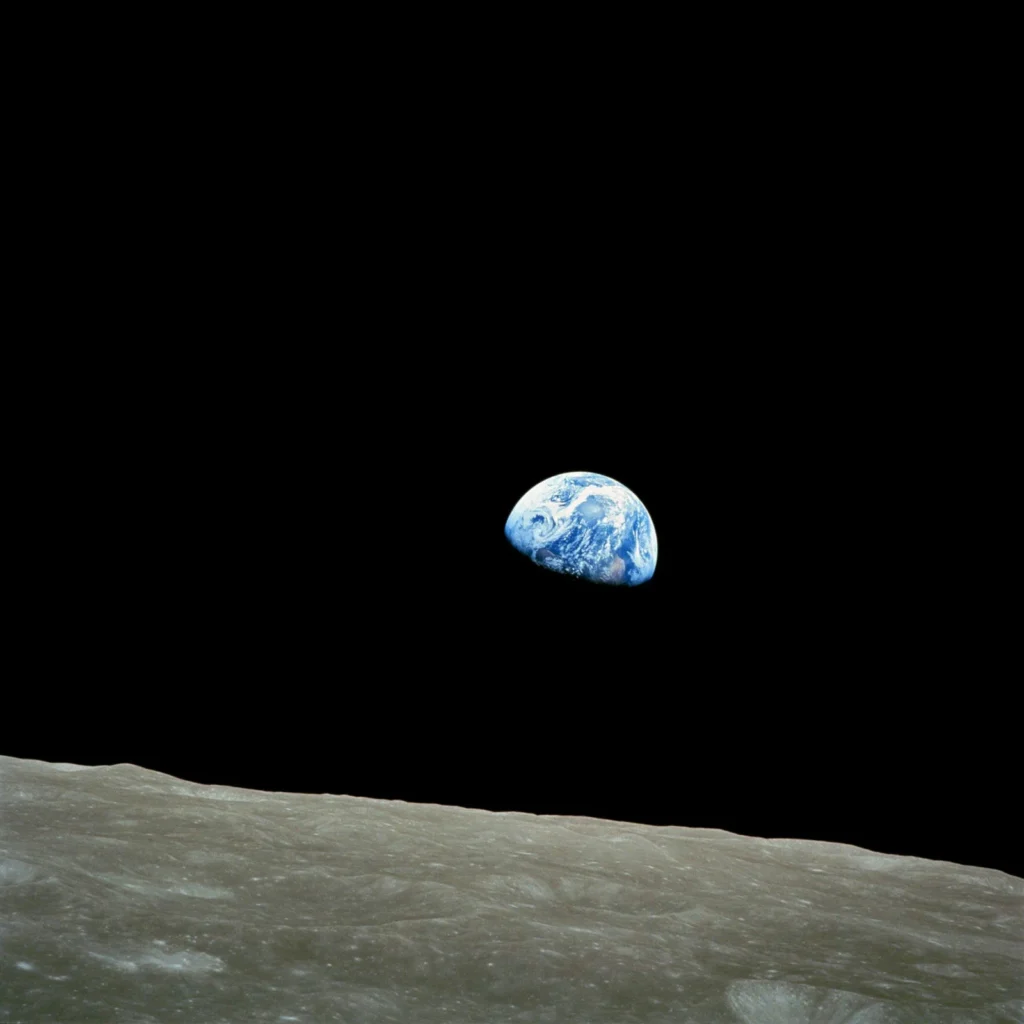
Now zoom out even further. You are on a rock and metal ball moving through space, covered mostly in water, with a thin breathable layer clinging to its surface like an afterthought. On that surface, organisms appear, evolve, and disappear — and somehow this feels normal.
Now consider that you live on that planet, and most days you don’t find any of it particularly remarkable. You wake up, check your phone, scroll through algorithmically selected fragments of other people’s lives, watch the news turn the world into a serialized drama, and go to sleep — completely inside the stream, never once stepping back to notice the stream itself.
That, right there, is a shift in attention most people recognize at least occasionally, even if they rarely stop to examine it.
It’s not about intelligence. It’s not about education or success or how many books you’ve read. Two people can live in the same city, consume the same information, and appear completely identical from the outside — while internally operating in fundamentally different modes of attention. One is immersed inside the narrative. The other has started noticing that it is a narrative. And most people move between both.

THE STREAM: Reality Is Not Questioned. It Is Streamed.
For most people, reality arrives as a continuous delivery system. Television presents life as structured emotional arcs. The 24-hour news cycle transforms global events into something that feels like a TV show with very high stakes. Social media — Facebook, Instagram, TikTok, X, Snapchat — serves algorithmically selected fragments of other people’s existence, curated not for truth but for engagement. YouTube and Reels create recommendation loops so smooth you can lose three hours without ever choosing a single thing to watch.
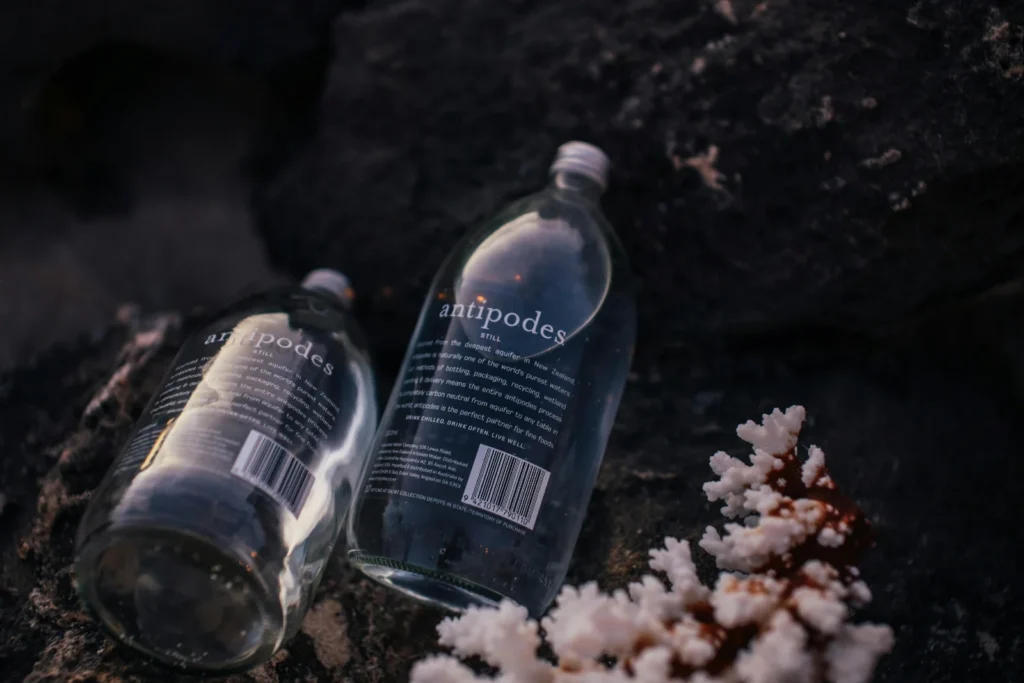
Even everyday consumption follows the same logic. Bottled water is the cleanest example. We live on a planet that is seventy percent water. Our bodies are sixty percent water. Water surrounds us, runs through us, constitutes us. Nobody knows exactly how many brands of bottled water exist worldwide — estimates run from several thousand to over ten thousand, with new ones appearing and disappearing every year.
Ten thousand distinct identities built around a substance that falls from the sky. And yet sometime in the late twentieth century it became a product — branded, differentiated, sold back to us as lifestyle and identity. A small reminder that even the most ordinary things are often pre-shaped before they reach perception. If we do that to water, we do it to everything.
Then there’s the entertainment layer beneath that: streaming platforms, cinematic universes, celebrity culture, reality television, sports leagues with permanent mythologies built around teams, seasons, and rivalries that function as continuous emotional storylines. All of it working together, all of it seamless, all of it designed — consciously or not — to keep attention inside the frame.
The matrix does not need to be technological. It can be cultural, linguistic, social. It does not persist through coercion — it persists through continuity. It becomes invisible precisely because it is everywhere at once.
When everything is part of the system, the system stops appearing as a system.
At a certain altitude of observation, something strange starts happening. Global events stop looking like isolated historical occurrences and start looking like recurring narrative templates with different actors. Cultures under similar pressures tend to reward similar behavioral strategies — and so certain patterns keep reappearing across different eras and contexts. Vladimir Putin. Donald Trump. Not unique patterns, but recurring forms expressed through different contexts — different individuals, same underlying template.
These patterns can also be understood in a broader Darwinian sense — not as literal roles, but as adaptive behavioral strategies repeatedly selected within cultural environments, resurfacing in different forms across time.
MEDIA, MOTION, AND PERCEPTION
There is a recurring tendency in how humans perceive the world: anything that moves tends to be treated, at least partially, as if it is alive.
The word animal itself comes from anima — breath, life, that which moves from within. In that sense, animals are not defined by appearance but by self-propelled motion, by being systems that generate movement internally rather than being pushed by something else.
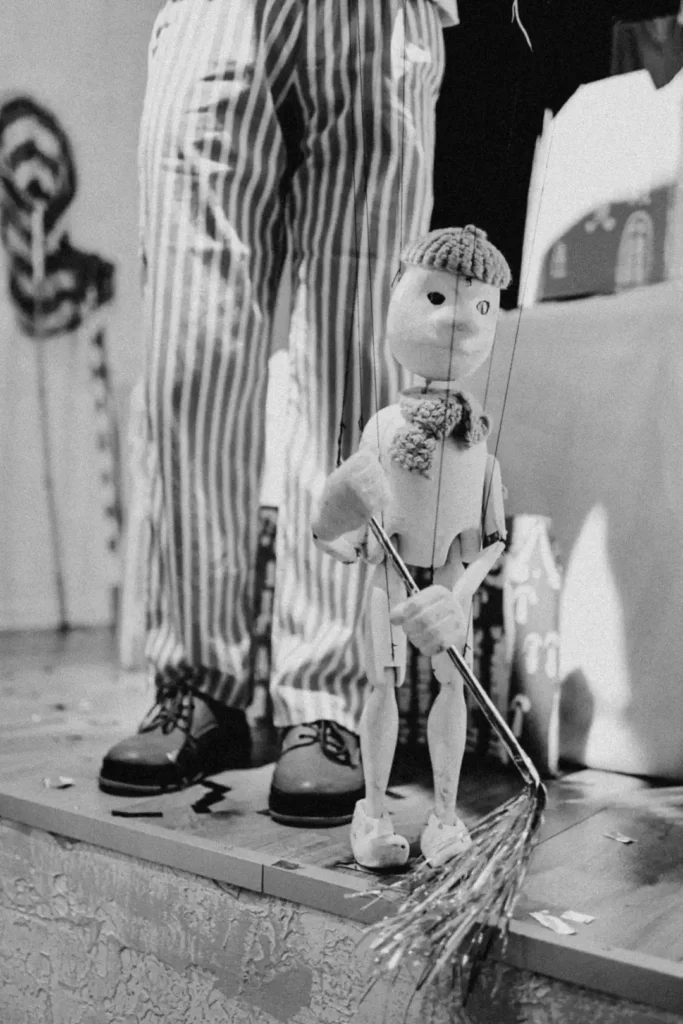
Animation is the external reconstruction of that principle. It does not create life, but it recomposes movement in a way that mimics living behavior closely enough for the mind to recognize intention in sequence.
Cartoons, doll theatre, mascots, and Muppets extend this further by reducing complex behavior into simplified, readable motion patterns—scripted characters that act, react, desire, and struggle in ways that feel alive not because they are, but because movement and the ability to produce sounds through speech (small mouth noises that carry meaning) are enough for perception to perceive autonomy and self-directed behavior.
This is why the boundary between categories begins to blur in culture. Animals in cartoons speak, not because they are meant to be literal animals, but because speech is a shortcut for intention. Cars gain faces and expressions, not because machines are alive, but because moving systems become easier to understand when they are treated as if they contain inner states. Even narratives like Planet of the Apes explore this same instability — where intelligence, embodiment, and identity are redistributed across non-human forms, and the mind is forced to reconsider what it recognizes as “self-like.”
Across all of these cases, nothing actually becomes alive through representation. What changes is perception: motion, when structured in certain ways, is enough for the mind to temporarily treat systems — biological, mechanical, or symbolic — as if they contain intention.
This is also why everyday language quietly relies on animal metaphors to describe people. We call each other dogs, snakes, pigs, lions, sheep. Not as literal classifications, but as compressed interpretations of behavior — instinctive translations of complex human patterns into familiar motion-forms drawn from the animal world.
What repeats across all of this is not identity, but interpretation. The mind does not strictly separate living beings, moving objects, and symbolic representations. It reads them through the same underlying filter: if something moves in a coherent way, it can temporarily be treated as if it has an inner source of intention.
THE METAPHOR: Telenovela Civilization vs. The Starship Enterprise
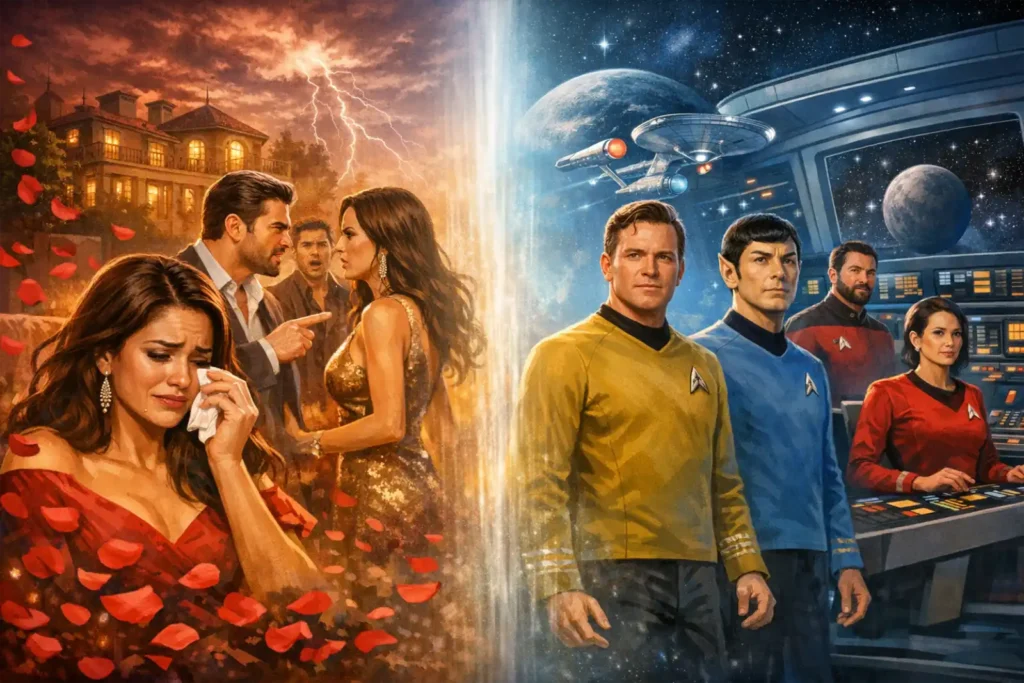
If you had to pick a metaphor for how most of human civilization operates, telenovela is uncomfortably accurate. Constant emotional drama. Shifting alliances. Status conflicts. Narrative escalation. People fully engaged in the unfolding story, reacting intensely to every development, completely absorbed in who did what to whom and what happens next — but almost never stepping outside the frame of the story to examine its structure.
The alternative isn’t detachment or coldness. It’s closer to the orientation of a Star Trek crew: curiosity replacing constant reaction, understanding systems rather than being consumed by them, deriving meaning not from participation in drama but from the observation of patterns beneath the drama.
This is not an emotional distinction. It is a positional one. The question is not whether you feel things deeply — it’s whether attention is fully inside the narrative, or capable of watching the narrative being constructed from a slight distance. And the interesting thing is that position shifts. The same person can be fully inside the telenovela on Monday and watching the whole frame from the outside on Tuesday.
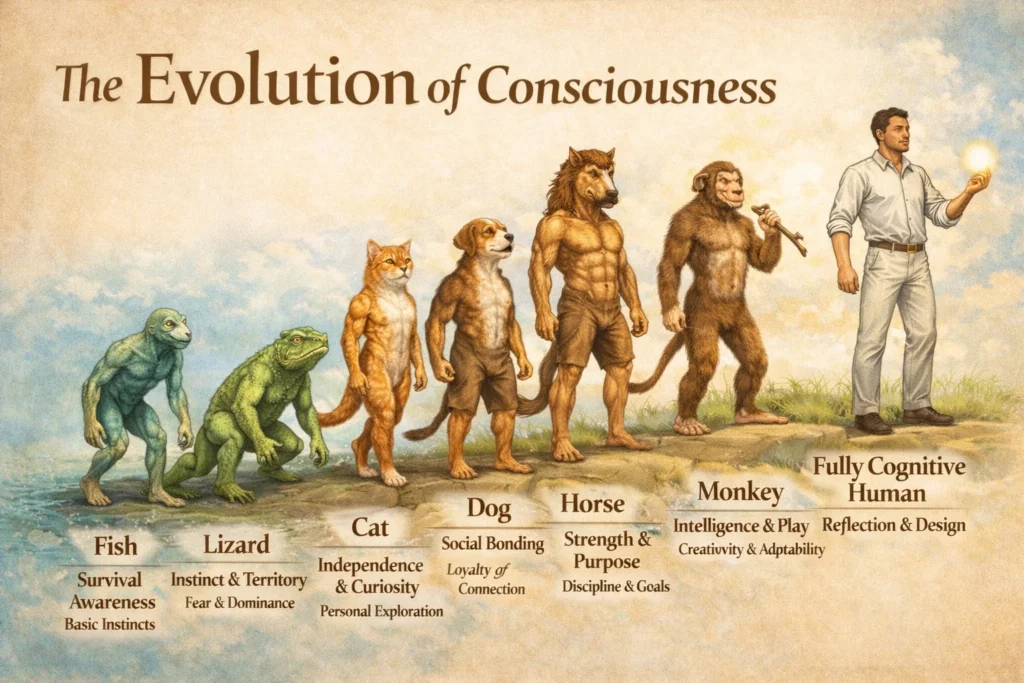
THE EVOLUTION
Here’s where it gets interesting. The reason moving between these modes is so difficult is that humans don’t operate from a single cognitive position — they operate from several simultaneously, most of them inherited from much older biological software.
These modes can be understood through an evolutionary framework in the Darwinian sense — as layered adaptive strategies shaped by survival pressures over time, expressed through behavior rather than identity. Think of what follows not as personality categories or evolutionary stages, but as metaphors — simplified names for recurring tendencies that appear in human behavior.
The key idea is not that you “become higher forms,” but that you develop the capacity to move between forms consciously — and recognize their costs as well as their strengths.
🐟 The Fish
| Strengths | Limitations |
|---|---|
| High adaptability to environment | Can lack direction or autonomy |
| Flows smoothly with conditions | Over-accommodation, loss of self-priority |
| Calm under uncertainty | Avoids necessary conflict |
| Reads emotional/social currents well | May not challenge harmful environments |
🦎 The Reptile
| Strengths | Limitations |
|---|---|
| Strong survival focus | Over-detects threat where none exists |
| Clear boundaries and protection instincts | Rigidity and defensiveness |
| Fast protective reactions | Difficulty trusting or relaxing control |
| Self-preservation priority | Can isolate from cooperation |
🐶 The Dog
| Strengths | Limitations |
|---|---|
| Loyalty and attachment | Over-dependence on approval |
| Strong sense of belonging | Fear of rejection or abandonment |
| Cooperative and protective | Loss of individuality in groups |
| Emotionally attuned to others | Vulnerable to manipulation |
🐱 The Cat
| Strengths | Limitations |
|---|---|
| Independence and self-sufficiency | Emotional distance or detachment |
| Observes before acting | Delay in engagement or commitment |
| Selective energy investment | Avoidance of necessary social bonds |
| Strong boundary awareness | Can appear aloof or uncooperative |
🐎 The Horse
| Strengths | Limitations |
|---|---|
| Discipline and endurance | Burnout tendencies |
| Strong forward momentum | Ignores emotional signals |
| Reliability and consistency | Resistance to change |
| Goal-oriented behavior | Identity tied to productivity |
🐒 The Monkey
| Strengths | Limitations |
|---|---|
| High social intelligence | Overthinking and comparison |
| Fast pattern recognition | Mental noise and interpretation overload |
| Playfulness and adaptability | Scattered attention |
| Learning through observation | Difficulty sustaining focus |
Metamorphosis Principle
The key transformation is not from one animal to another, but from unconscious expression to conscious modulation.
Maturity is the ability to notice patterns like: “this is the Fish responding,” or “this is the Reptile reacting,” rather than identifying with them as identity.
Development is not a ladder of higher forms, but a shift in awareness — the ability to move between inherited biological patterns without being controlled by any single one.
All of these modes remain active in adult human consciousness. They do not disappear with education or maturity. They run in the background, shaping perception and reaction.
What separates the human level is not the elimination of these layers, but the capacity for metacognition — the ability to observe them as patterns rather than identity.
From inside this frame, social life begins to resemble a continuous behavioral ecosystem — readable, patterned, and strangely consistent.
A view from high altitude
There is a reason the eagle appears across cultures as a symbol not of power, but of seeing. It does not move faster than other animals. It simply sees from higher. What looks like chaos from inside the stream — the competing currents, the noise, the constant motion — resolves, from altitude, into pattern.
That is the invitation. Not to escape the human layers, but to develop the eagle’s perspective on them. To watch the Fish adapt, the Dog seek belonging, the Monkey compare — and recognize all of it without being entirely consumed by it.
If you want to fuck with an eagles, you need to learn to fly. Thievery Corporation’s Is It Over lives in that altitude.
THE SHIFT: The Operating System Upgrade Nobody Warned You About
The transition between these modes is almost never sudden. It unfolds over time through cycles of clarity, regression, and reorganization of perception.
Thoughts that once felt like identity begin to appear as events within awareness. Emotional reactions become observable rather than absolute. Social narratives begin to look like systems rather than truths.
The biological substrate remains unchanged. What changes is the interpretive layer — the structure through which experience is assembled.
Some traditions call this “awakening.” Psychology might describe parts of it as metacognition or shifts in self-perception. Whatever language is used, the experience often feels less like discovering a new world than noticing a structure that had been operating unnoticed — a slow metamorphosis of perception itself, a reconfiguration of how reality is organized from within experience.
There is a particular set of conditions under which this becomes more noticeable. Not defined by intelligence or education, but by a cognitive orientation — part aesthetic sensitivity, part systems-awareness, and part reflective distance. A mind that naturally moves between lived experience and structural interpretation without needing to collapse one into the other.
Such a configuration tends to be drawn toward frameworks that treat consciousness as observable and reorganizable rather than fixed. It does not require escape from ordinary life, but it becomes increasingly aware of how experience is assembled while it is being lived.
AND THEN WHAT?
Here is what remains consistent throughout all of this: reality does not disappear when it is seen differently.
Life continues. The stream continues. The story continues. Relationships remain. Work remains. Politics remains. Ordinary life remains.
What changes is position.
And from that position, something becomes available — not as belief or method, but as capacity: the ability to observe how experience is constructed while it is being lived, and to participate in it with increasing awareness of its formation.
Not escape from the story.
But awareness inside it.
And Then, The Basics
Awareness without structure is incomplete. Seeing the stream clearly is valuable — but you still wake up every morning in a body that needs sleep, food, and movement. You still have time to spend, people to choose, and a life to design.
The Complete Picture of a Good Life is the practical side of this — twelve things, grounded and actionable, that form the foundation a good life is actually built on. The observer still needs a life worth observing.