
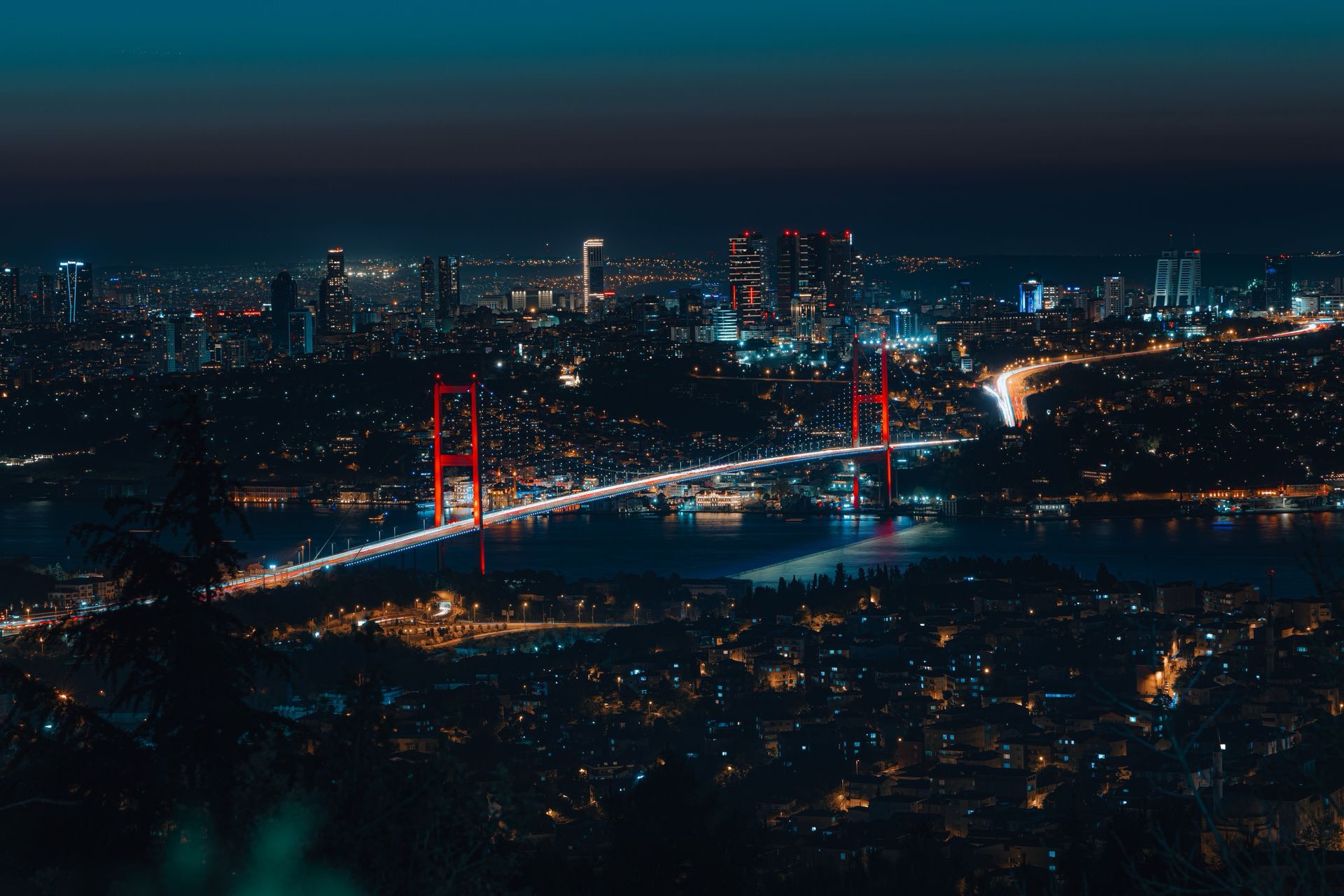
The strangest thing about a long journey is what it does to the place you left. You return to find that home has become as foreign as anywhere you visited. Not because home changed. Because you briefly saw it from outside.
That is what the bus to Istanbul did.
There is a version of Turkey that exists in the Croatian imagination. It is shabby. Vaguely threatening. It smells of cheap cigarettes and unresolved history. Nobody sits you down and explains this picture. It arrives the way all inherited pictures arrive — through the air, absorbed before you have the judgment to question it.
I carried this picture for forty years. Then I took the bus to Istanbul.
The country you leave
Croatia is a country of four million people. It has nearly four million more living outside it — a diaspora almost equal in size to the population that stayed. That ratio places it among the most extreme cases in the world. The exodus began in the 15th century. The reason was the Ottoman advance from the southeast.
Five centuries later, people are still leaving.
The territory itself was shaped by three empires simultaneously, none of them Croatian. The Ottomans pressed from the southeast. The Habsburgs administered the interior — the bureaucracy, Zagreb’s architecture, the Catholic institutional structure, the fixed orientation toward Vienna as the definition of civilization. The Venetians held the coast — the stone towns, the maritime culture, the Adriatic aesthetic that makes Dalmatia resemble Italy because much of it was built by Italians.
Three design logics, one small territory. The layers don’t fully resolve. They’re still visible.
What’s less visible is what they left in the language. Croatians drink kava and eat čevapi and use words like čarapa, jastuk, pendžer — sock, pillow, window — without registering that these are Turkish. The Ottoman layer is woven into daily life while the culture defines itself in explicit opposition to the Ottoman. The insult ko Turcin — like a Turk, meaning rough, uncivilized, impossible — remains in active use. Five centuries of frontier anxiety compressed into two words, still in daily circulation.
This is the place the bus departs from. This is what a person carries without knowing they’re carrying it.
The country you’re going to
Turkey has a population of 85 million — twenty times Croatia’s. It fields the second largest standing army in NATO. Its economy is largely self-sustaining: significant agricultural production, substantial manufacturing, an indigenous defense industry that now exports military drones globally. Not a raw materials economy. A producing economy of real scale.
The Turkish diaspora exists — around five to six million people abroad, concentrated heavily in Germany from the guest worker programs that began in the 1960s. But relative to a home population of 85 million, that is roughly seven percent. Croatia’s diaspora approaches eighty percent of its home population.
Two diasporas, two completely different stories. The Turks who went to Germany went as workers to a labor-hungry economy. They left a large, functioning country for specific economic reasons. The Croatians who began leaving in the 15th century left because the Ottoman advance made staying dangerous. The exodus never fully stopped.
But the image that formed in Central European perception was built from the visible diaspora — the Turkish workers in German factory towns, the communities in the unfashionable parts of cities. That image got projected back onto Turkey itself. The worker who left became the representative of the country he left. That is not knowledge. That is a story assembled from a fragment.
Two countries, two scales
| Croatia | Turkey | |
|---|---|---|
| Population | ~4 million | ~85 million |
| Territory | 56,594 km² | 783,356 km² |
| Diaspora abroad | ~3.2 million (~80%) | ~5–6 million (~7%) |
| Tourism arrivals | ~17 million/yr | ~52 million/yr |
| Tourism / GDP | ~26% (highest in EU) | ~10–11% |
| Tourism revenue | ~$16 billion | ~$61 billion |
| GDP per capita (nominal) | ~$17,770 | ~$13,000 |
| GDP per capita (PPP) | ~$42,600 | ~$38,000 (est.) |
| Coastline | 5,835 km + 1,200 islands | ~7,200 km total |
| Charter fleet | ~4,400 vessels (world’s largest) | Growing — Bodrum, Marmaris, Göcek |
| NATO army rank | — | 2nd largest |
| Bus Zagreb → Istanbul | ~1,167 km / ~22 hours | |
Tourism contributes nearly 26 percent of Croatia’s GDP — the highest share of any EU member state. GDP per capita in nominal terms favors Croatia, but adjusted for purchasing power the gap narrows considerably. The nautical sector is where Croatia genuinely leads: the largest charter fleet in the world, nearly 6,000 kilometers of coastline, over 1,200 islands.
Beyond Istanbul, Turkey holds Cappadocia with its volcanic landscape and cave architecture, Pamukkale’s white calcium terraces, the Aegean coast with Ephesus and Bodrum, Antalya on the Mediterranean. It is a country the size of France and Germany combined. The picture of the shabby third world was wrong in almost every direction simultaneously.
The approach — 1,167 km, 22 hours
Zagreb to Istanbul by bus is approximately 1,167 kilometers. The journey takes around 22 hours. A flight covers the same distance in under two hours.
The difference is not just time. A flight compresses the transition into nothing — you step into one reality and step out into another, with no experience of the distance between them. The bus makes you earn the arrival. You watch Croatia become Serbia become Bulgaria become Turkey. The architecture shifts. The signage changes alphabet. The texture of towns evolves gradually. The light is different in the southeast.
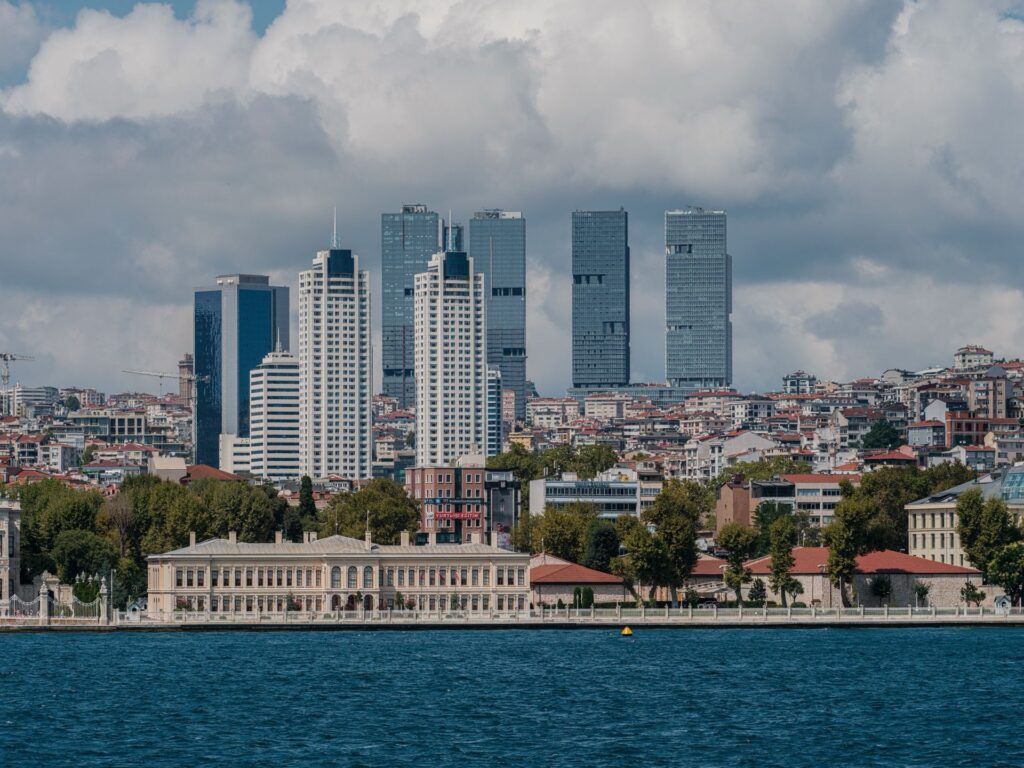
By the time the skyline of Istanbul appears, you have felt the distance. You have crossed something real.
Skyscrapers. Not one or two — a skyline extending in every direction across two continents, the kind of density I had previously seen only in American films. Towers over water, bridges over the Bosphorus, fifteen million people living in a city whose scale simply hadn’t existed in my internal picture of where I was going.
I had come from a country of four million traveling to a place the culture around me had quietly filed as third world. The filing was wrong. Not slightly wrong. Categorically wrong.
The name itself is worth a pause. Istanbul comes from the Greek eis tin polin — to the city. Byzantine Greeks called Constantinople simply hē Polis. The city. Not a city. The one requiring no further qualification. The city your inherited picture filed as backward and peripheral was, for most of recorded history, simply — the center. The place everything else was measured against.
Zagreb vs Istanbul — the scale in numbers
| Zagreb | Istanbul | |
|---|---|---|
| Population (city) | ~775,000 | ~15.7 million |
| Metro area | ~1.1 million | ~15.7 million |
| City area | 641 km² | 5,343 km² |
| Population density | ~1,200/km² | ~2,934/km² |
| Median age | ~43 years | ~34 years |
| Gender split | 53% female / 47% male | ~50/50 |
| Avg. monthly net salary | ~€1,555 | ~€700–900 (PPP: comparable) |
| Mosques / churches | Predominantly Catholic | 3,623 mosques, 143 churches, 16 synagogues |
| Spans two continents | No | Yes — Europe and Asia |
| Distance between them | ~1,167 km by road / ~22 hours by bus | |
Zagreb holds a fifth of Croatia’s entire population. Against Istanbul it is a village, as anyone who has made the journey will tell you. The median age gap tells its own story — Croatia skews older, one of the oldest median ages in Europe. Istanbul skews younger. You feel that difference in the energy of the streets.
The food — a civilization on a plate
Croatian cuisine is honest and often excellent — but narrow. The Venetian coast brought pasta and seafood. The Austro-Hungarian interior brought meat, schnitzel, strudel. The Ottoman legacy brought čevapi and kebabs, though nobody calls them Ottoman. Three empires, three culinary registers, not always in conversation with each other.
Turkish cuisine is something else entirely.
Mezes that arrive in waves before the main course — stuffed vine leaves, roasted aubergine, fresh cheese with herbs, walnut pastes, yoghurt dishes, spiced lentil soups. Bread baked in clay ovens. Slow-cooked lamb dishes with names that go back centuries. Spice markets where the stalls sell forty kinds of dried herb, pepper, and resin. Street food operating at a level of sophistication that most European restaurant kitchens don’t reach.
The diversity is civilizational, not just regional. Turkey sits at the crossroads of the Silk Road, of Byzantine, Ottoman, Persian, Arab, and Central Asian culinary traditions. The result is a cuisine with genuine depth — not just variety of dishes but variety of logic, different underlying philosophies about what food is for and how it should be prepared.
The shock is real. You eat well in Croatia. You eat differently in Istanbul — in a way that makes you realize how many assumptions about what a meal is you had been carrying without knowing it.
Rockets and spaceships — the architecture of the sacred
A church is a rocket. The logic is vertical — the spire pointing upward, the architecture of aspiration, stone reaching toward the sky as if to close the distance between human and divine. Gothic cathedrals took this to its extreme: every line pulling upward, gravity defied through engineering, the building itself a prayer rendered in stone.
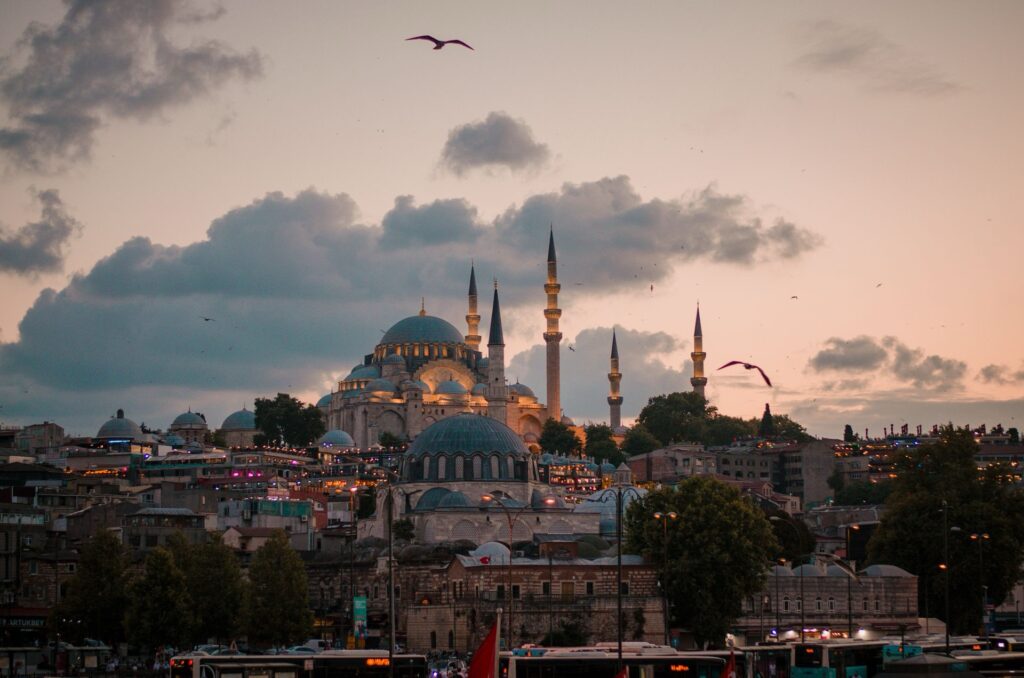
A mosque is something else. The dome first — not a spire but a sphere, a compression of the sky brought down to earth, a universe contained. Around it the minarets rise — but they are not the building, they are antennas, transmitters. The central logic is the dome, and the dome is round. It does not reach for the sky. It replicates it.
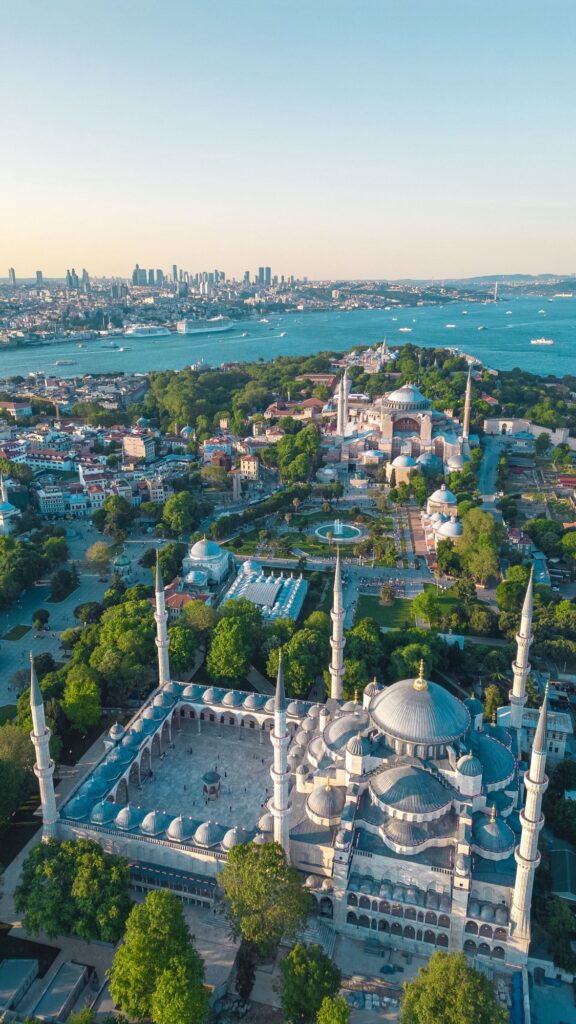
Standing in Istanbul looking at the Sultanahmet skyline — the Blue Mosque, Hagia Sophia, the layered domes stepping down toward the Bosphorus — the impression is of something that arrived from elsewhere. Where the Gothic church says I am reaching upward, the Ottoman mosque says the cosmos is already here, present, surrounding.
Hagia Sophia alone is enough to recalibrate your sense of what architecture can do. Built in 537 AD, it remained the largest enclosed space in the world for nearly a thousand years. The dome appears to float, lit from windows at its base so that the structure seems to dissolve into light rather than rest on walls.
You leave with a different eye for buildings. The church spires of Zagreb, which you stopped seeing years ago, suddenly look like what they are — rockets. Pointing at something.
“There is a river. If you swim with the current, it will be more comfortable”
The religion in the air
Western travelers know, intellectually, that Turkey is a Muslim country. What they don’t know — what cannot be known until you stand inside it — is what that actually means in practice.
In much of Western Europe religion runs in the background. National television broadcasts church mass. The calendar is built around Christian holidays. Crosses appear on hillsides and the walls of public buildings. But it has been absorbed so thoroughly into the ambient environment that most people stopped registering it as religious infrastructure long ago. It became wallpaper.
And then there is Christmas. The birth of a religious prophet, filtered through decades of commercial campaigns, producing Santa Claus, pine trees, and the most significant retail event of the Western calendar. Sacred and commercial so thoroughly merged that the boundary between them is no longer visible.
Istanbul is operating on different logic entirely. Five times a day the call to prayer sounds simultaneously from hundreds of minarets across the city. It does not ask for your attention. It takes it. For a few minutes the entire sonic environment of fifteen million people is interrupted and reoriented. A reminder, broadcast at full volume across the whole city, that there is a dimension to existence that is not commercial, not political, not individual. This is religion as active infrastructure. Running continuously. Publicly. Without apology.
There are places in Istanbul where you can have dinner — proper food, wine if you want it — while the Sufi ceremony unfolds in the same room. Performers spinning in white robes, the music building and releasing, the sacred and the social occupying the same space without contradiction. Istanbul doesn’t make the Western distinction between sacred here and social there. It is all happening at once, in the same room, on the same evening.
The aesthetic observation deserves to be stated directly. Islamic visual communication is built on geometry, pattern, and calligraphy — no figurative representation of the divine, no suffering figure on a cross. For someone with a design eye, this is immediately legible as a different and in many ways more coherent visual philosophy. Abstraction over illustration. Pattern over narrative. The infinite suggested through repetition rather than depicted through a human face.
Western Christianity went the other direction — the drama of the crucifixion repeated on every corner. A dead man on a cross is a powerful image the first time. After ten thousand repetitions on roundabouts and supermarket walls it has been absorbed into visual noise. The sacred becomes wallpaper through overexposure, not through irreverence.
This is not a theological argument. It is a designer’s observation: the geometry is more interesting, the daily practice more honest about what it is. Istanbul was the first place I personally encountered religion that felt neither theatrical nor commercial — simply present, running, indifferent to whether any particular observer found it meaningful. That observation doesn’t require converting to anything. It just requires looking.
The cats
Istanbul has a well-known relationship with cats. They are everywhere — in the streets, the cafes, the markets, the mosques. Not stray in the usual sense. Not owned either. Something in between, or outside that distinction entirely.
Many wear collars. They are fed, known by name in their neighborhoods, cared for collectively. The city contains them the way a city contains its people — as residents with rights.
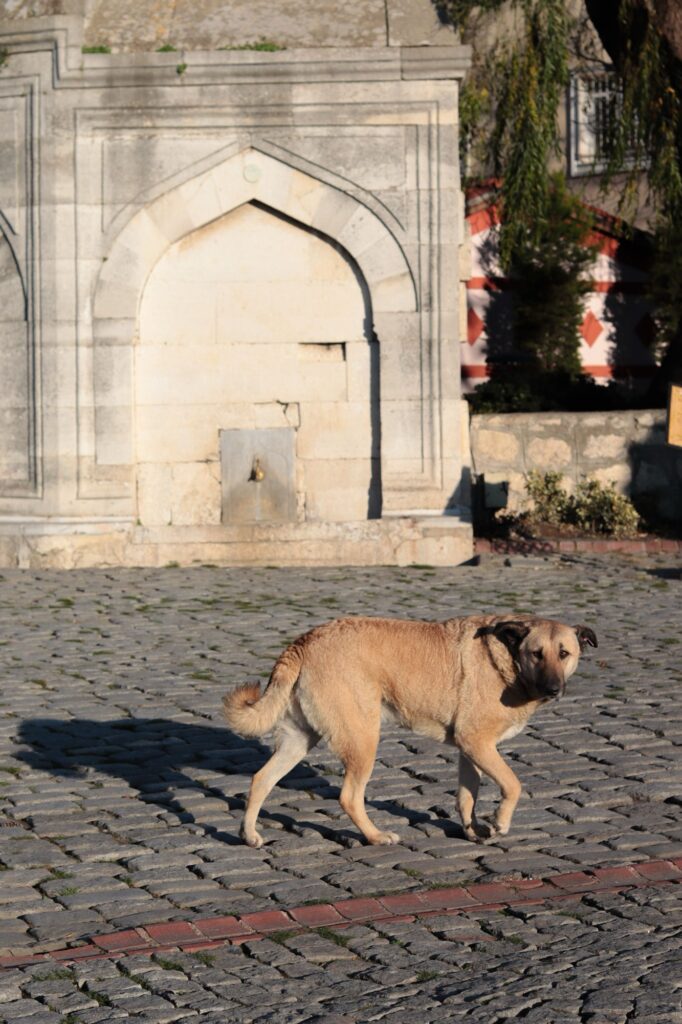
The dogs are the same. Large Turkish street dogs, also collared, also fed and monitored by the municipality, sleeping in doorways and parks with the unhurried authority of animals that know they belong.
But it is the cats in the mosque that stay with you. Inside one of the great mosques — the dome above doing something to light and proportion that no photograph captures correctly — there is a cat. Collared, unhurried, moving across the carpet with complete ownership of the situation. Guards watch the tourists. Nobody watches the cat.
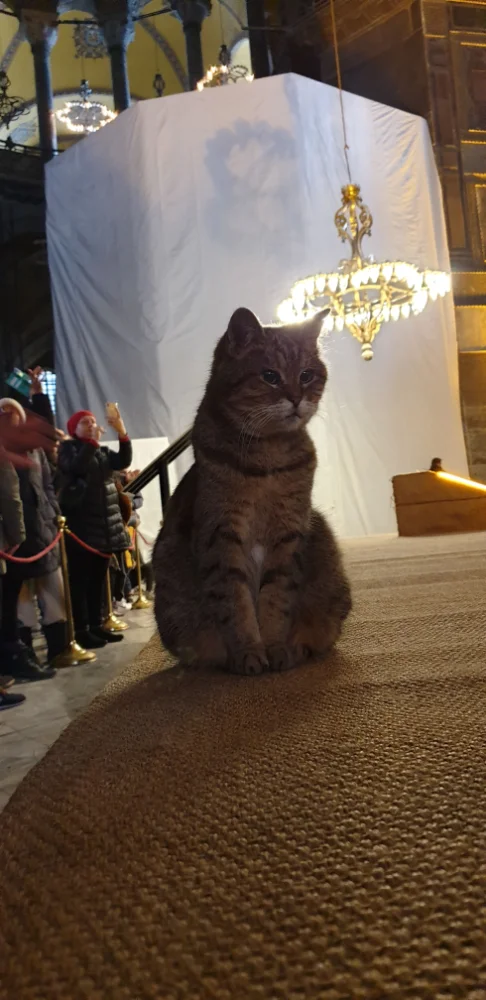
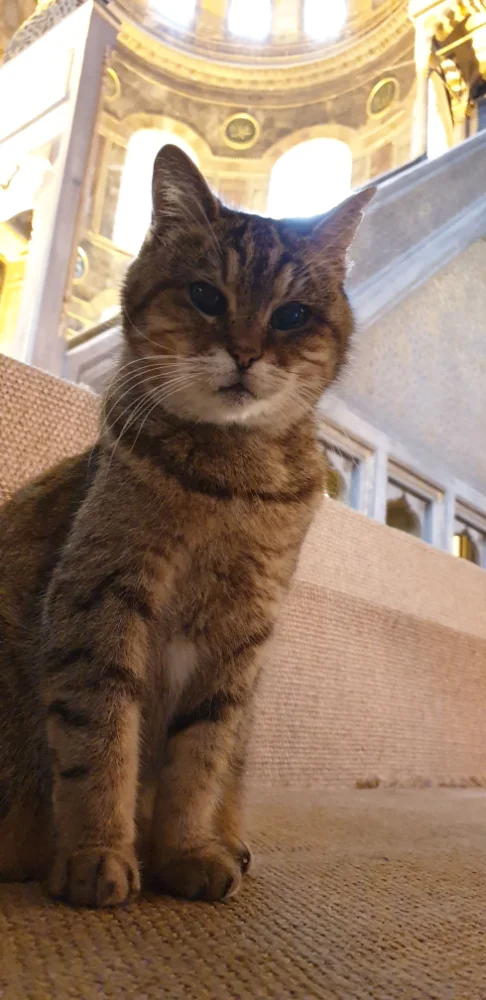
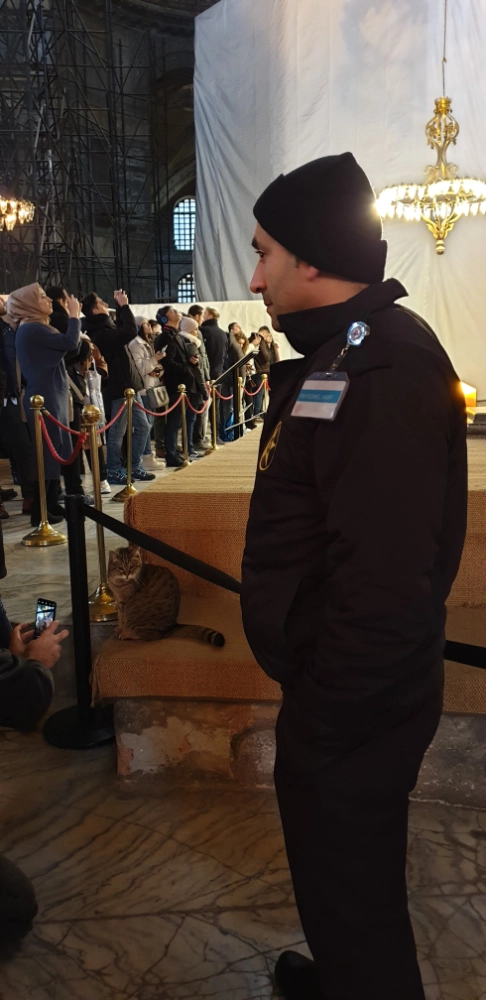
It approached the area near the mihrab — the most sacred point in the room — and sat there with the stillness cats achieve when they have decided a place belongs to them. It looked out at the tourists with an expression that suggested it had seen many thousands of us and found us collectively unremarkable.
In the spaceship mosque, the cat looked out at the assembled humans with something that resembled patience. It was not performing holiness. It was simply present, in the way cats are present — completely, without explanation. You take the picture. You know it will not capture what you are actually seeing.
Coming home
I had been back in Zagreb for perhaps two hours when I heard the church bells.
I had been hearing those bells my entire life. I had stopped hearing them the way you stop hearing any constant sound — through the efficiency of a brain that categorizes, files, and moves on. Background. Not information.
But I had just spent days in a city where the sacred interrupted the day at full volume, and suddenly the bells were not background. They were the same thing. Different frequency, different aesthetic, the same structural function — marking time, orienting the community, transmitting that something larger than daily life was present and still operating.
I had been living inside a religious information architecture my entire life without ever stepping outside it to look at it. Istanbul gave me the outside. Zagreb had not changed while I was gone. Something in the way I saw it had.
The mechanism
Every person alive is navigating reality with a set of maps they did not draw.
Some maps are personal — assembled from early experience, from conclusions formed before you had the tools to form them well. Others are cultural — inherited images of other places, other peoples, other ways of organizing a life. Both feel like knowledge. Neither was chosen.
The problem with these maps is not that they are wrong, though many are. The problem is that you cannot see them. A map you know is a map can be examined and updated. A map you don’t know is a map feels like reality itself. You navigate by it without realizing you are navigating by anything.
The only diagnostic tool available is the dissonance. The moment reality and the picture don’t match — when the skyline appears and it is larger and more serious than anything the image contained — that is the only moment the map becomes visible. Before the contradiction, invisible. After it, you cannot unsee it.
This is what genuine contact with the unfamiliar does that no amount of reading can fully replicate. You can accumulate accurate information about Istanbul and the map stays intact. Stand at the bus window as the skyline appears and the picture breaks in real time. The contradiction arrives in the body before the mind has a chance to file it.
What this costs
Every wrong map is a navigation error waiting to happen.
The picture of Turkey as shabby and peripheral — harmless, embarrassing in retrospect. But the same mechanism that produced that picture produces others. The picture of what is possible in a life like yours. The picture of what kind of person you are. The picture of what you are allowed to want.
These pictures are navigation instruments in active use right now. Most were formed before you had the information or judgment to form them well. Some are wrong in ways that matter — not abstractly, but concretely, in the decisions they shape, in the directions they close before you notice they were open.
A finite life navigating by wrong maps wastes time it does not have.
The bus back from Istanbul crosses the same border in reverse. The landscape shifts in the same way, mirrored. But something is different on the return. The place you left is no longer exactly the place you’re arriving at. Same country. Same čevapi nobody thinks of as Turkish. Same bells — which you can now hear again.
Different maps. You update the ones you can see. You stay alert for the ones you can’t. There are always more maps.
The dissonance, when it comes, is not a problem.
It is the most useful thing that will happen to you today.
The dervishes spin because spinning is how the mind escapes its own fixed patterns. Every rotation is a small confrontation with the unexpected. Every disruption of what was expected is how intelligence actually grows. If that idea interests you — how the mind learns, how novelty expands what you are capable of, why surprise is the real teacher — the thinking continues here: How the Mind Learns to Spin.
Istanbul made the European capitals legible as a category. Once you’ve seen a city running on different logic, the shared operating system underneath Paris, London, Amsterdam, Rome, and Belgrade becomes visible. That tour and what it actually reveals: Under the Cathedral — The European Classics