
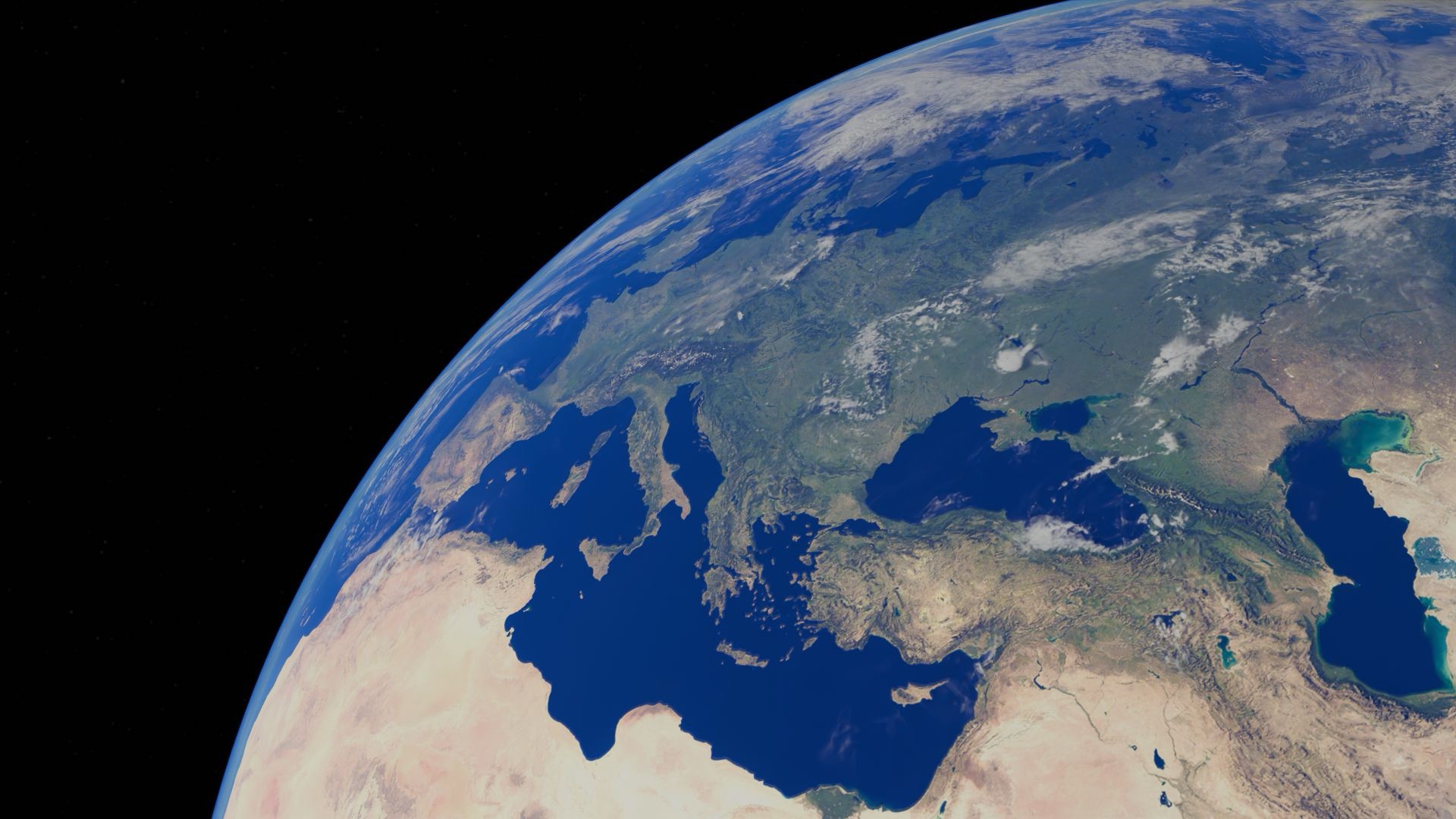
The planet was always a theme park. Not in the diminishing sense — not managed, not artificial, not designed for consumption. But in the structural sense: an extraordinary set of attractions distributed across a sphere, each one genuinely different from the others, with humans born into it at various entrance points and given a finite amount of time to move through some portion of it.
The Sahara is one attraction. The Amazon is another. Tokyo, Istanbul, the Bosphorus, a coastal town, a reef in the Pacific. Each one a specific set of conditions that doesn’t exist anywhere else in quite the same configuration.
You are born near one of them. That is your starting point.
The soil
Every person begins somewhere specific. A city, a village, a coastline, a landlocked valley. The place you start in is not a limitation — it is a coordinate. The first data point in a personal map that will either expand or stay roughly where it started.
The soil shapes the lens before you are old enough to know you have one. What feels normal. What feels foreign. Which problems are visible and which are invisible. What a meal is, what a street sounds like at night, what relationship between people and institutions feels natural. All of this arrives before you have the capacity to evaluate it.
This is not ideology or culture in the abstract. It is the specific texture of the environment that formed you. A person raised near the sea develops a different relationship with space and horizon than someone raised in a dense inland city. A person raised where everyone knows each other develops a different social baseline than someone raised in urban anonymity.
The soil is the starting point on the map. Not the destination. Not the ceiling. Just the conditions that were present when the formation happened.
The nodes
Movement through the planet is movement through its attractions. Each place visited is a node — a specific set of conditions that doesn’t exist where you came from, which means it installs something new into the reference library.
A city you assumed was lesser turns out to be the center of recorded history. A place you inherited as the enemy turns out to be people living their lives. A building you didn’t know existed recalibrates your sense of what architecture can do. A cuisine reveals that your assumptions about what food is were local, not universal.
The nodes don’t replace the soil. They expand the range of what the person from that soil can perceive and hold simultaneously. Someone who has only ever been in one kind of place has a single reference point — which means they cannot see it as a reference point at all. It is just reality. Each additional node makes the previous ones visible as specific rather than universal.
This is the actual value of movement. Not the photographs, not the status, not the experience as consumption. The expansion of the lens. The gradual accumulation of reference points that allow you to see your own starting coordinate more clearly.
The theme park homogenizes
The global village introduces a complication.
When every entrance gate to the planet starts looking similar — the same chains, the same interfaces, the same algorithmic cultural inputs arriving on the same devices in cities and villages simultaneously — the soil effect weakens. A person growing up anywhere today is partly shaped by the specific local conditions and partly shaped by the same global media, the same platforms, the same exported aesthetics and values.
The theme park is becoming more internally consistent. The attractions still differ. But the visitor arrives at each one having already been exposed to it through screens, having already formed a picture, having already been partially standardized by the infrastructure of global culture.
This is not catastrophe. It is just the current condition. The nodes still differ. Presence in them still installs something that information alone cannot. The soil still matters — what you grew up next to, what language you heard, what relationship with landscape and community was your baseline.
But the edges are softer. The contrast between the starting point and the unfamiliar is less sharp than it was. Which means the recalibration that genuine encounter with a different place produces requires more conscious attention than it used to. You have to actually look. The default is increasingly to confirm what you already know.
What this means for a life
The planet is the theme park. You get one pass through it, of uncertain duration, starting from wherever you were dropped in.
The question is not how many attractions you visit — that is just accumulation, and accumulation without attention produces nothing useful. The question is whether the movement through the attractions actually changes the lens. Whether each new node genuinely expands what you can see and hold simultaneously, or whether you move through it and return to the same baseline unchanged.
The soil is where you started. It is not who you are. But it is the material you are working with, and knowing it clearly is the beginning of being able to work with it consciously.
The theme park was always here. Most people spend their lives in a very small section of it, near the entrance they came through, visiting the same attractions on a loop.
The ones who move further don’t necessarily find better attractions. They find out more about who they are by seeing what they brought with them into each new place.
The attraction reveals the visitor as much as the visitor experiences the attraction.
That is the real value of the journey.
What a specific journey through the theme park actually looks like — one bus ride, one broken picture, and what it revealed about the place left behind: What the Road to Istanbul Taught Me About Home.
On what the European classics deliver versus what the picture promised, city by city: Under the Cathedral — The European Classics.
The broader framework on what travel does in a world where every destination is already visible before arrival: Managed Horizons.