
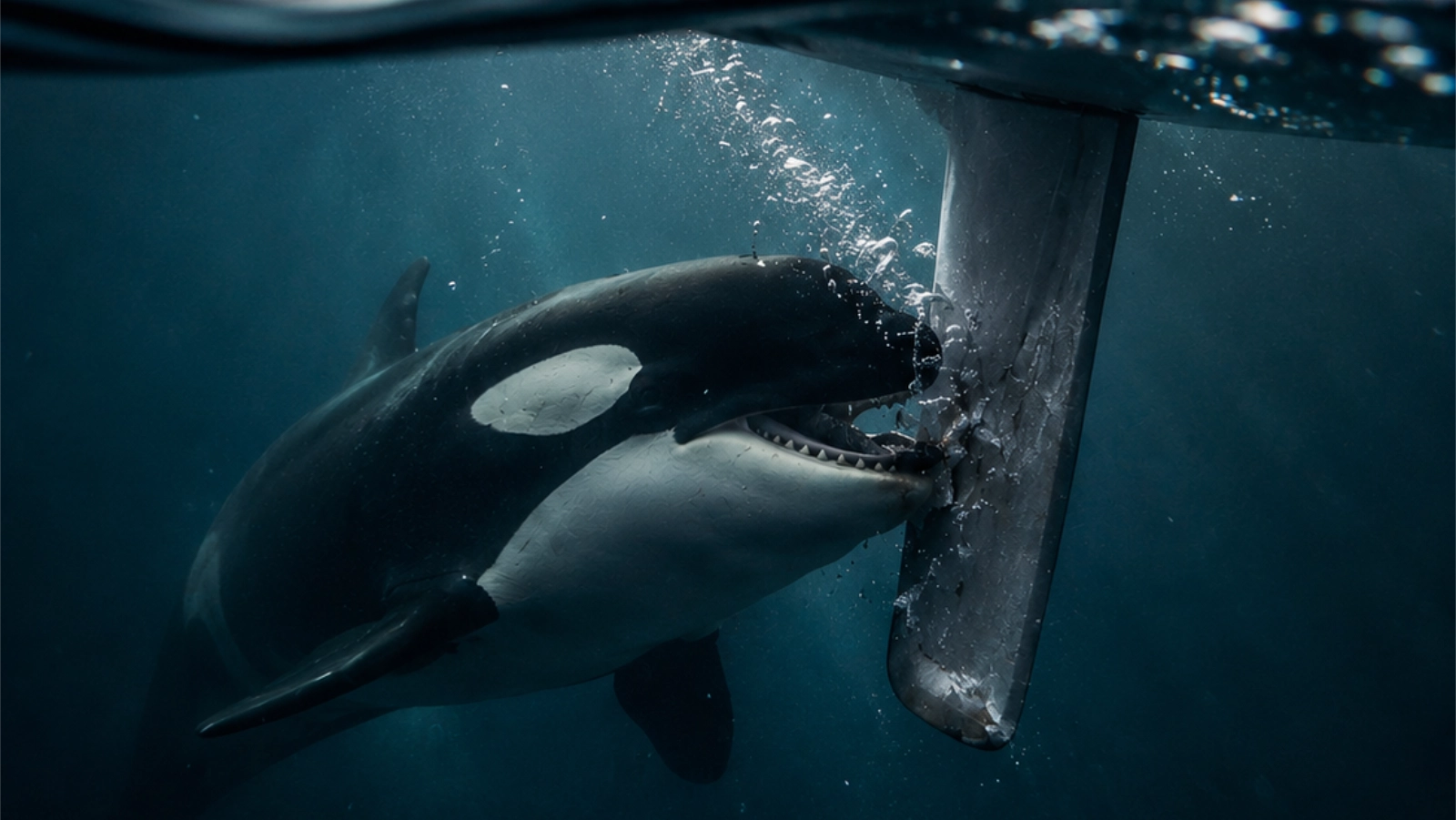
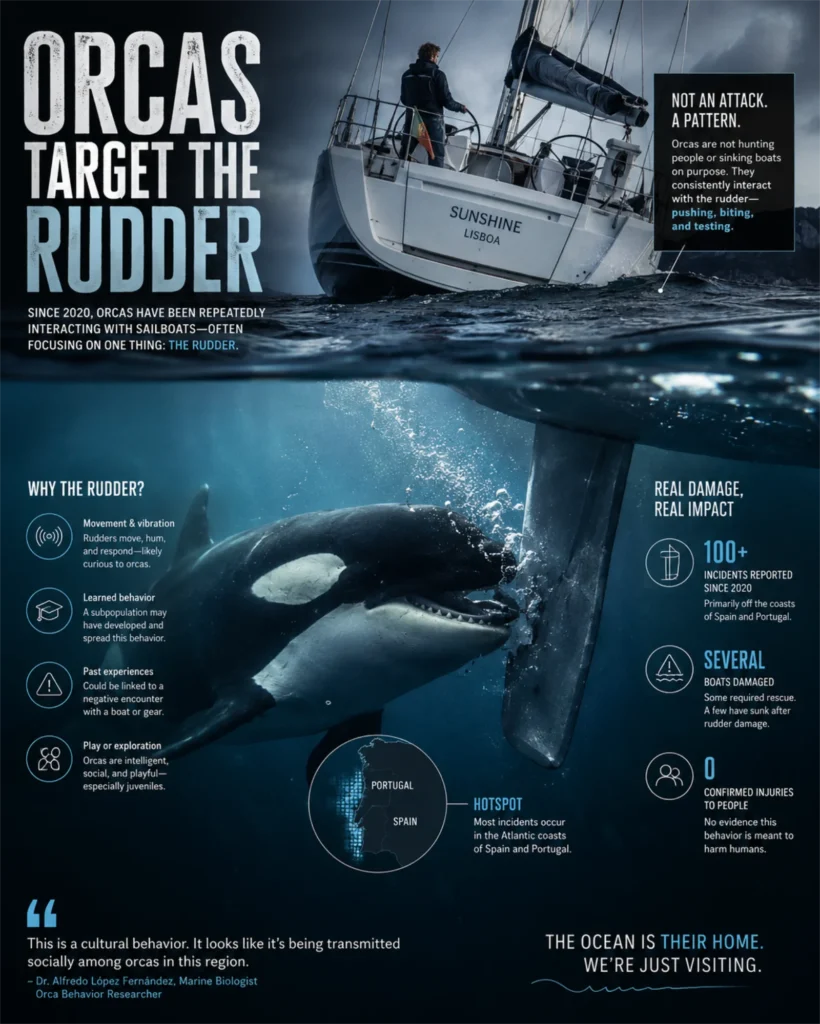
In 2020, a group of orcas off the coast of Portugal and Spain began doing something nobody had seen before.
They started disabling boats.
Not attacking them dramatically. Not harming the people aboard. Just finding the rudder — the single mechanism that gives a vessel its direction — and methodically removing it. They figured out how to do this, and then they taught each other. Older orcas showed younger ones. The technique spread through the group the way knowledge spreads through any intelligent social species.
Five years later they are still doing it. Seventeen boats sunk. Zero humans hurt. No signs of stopping.
The internet, almost without exception, took the side of the orcas.
Nobody asked why.
The Rudder
Before we go further it is worth pausing on the specific choice of target.
Not the sail. Not the hull. Not the humans. The rudder. The part that determines where the vessel goes. Remove it and the boat doesn’t sink immediately — it drifts. The people aboard are safe but suddenly, completely, without the ability to choose their direction.
Scientists offer several explanations. Stress response. Play behavior that escalated. A single traumatized female who started it after a collision with a boat and whose behavior spread through social learning. All of these explanations are probably partly true.
But they don’t fully account for the precision. The consistency. The fact that across five years and multiple animals the target remains the same. The rudder. Always the rudder.
Whatever the mechanism — the result is a message. Whether the orcas intended it as one is almost beside the point.
You are not going anywhere I haven’t agreed to.
The Pattern
The orcas are the most visible part of something larger.
Think back across the last thirty years and look at where the major disease events came from.
SARS, 2002. Origin: bats and civets in southern China, sold in wildlife markets under conditions of extreme crowding and stress.
H1N1 swine flu, 2009. Origin: pigs, in industrial farming conditions where different flu strains mix and mutate in populations of animals living in spaces not designed for their biology.
Bird flu, multiple outbreaks across multiple decades. Origin: poultry, in industrial conditions.
Covid-19, 2020. Origin: almost certainly bats, through an intermediate host, in conditions created by the intersection of wildlife trade and industrial animal handling.
This is not a conspiracy. This is not punishment. This is biology operating exactly as biology operates — viruses that animals have carried harmlessly for centuries finding new hosts when the conditions force them into contact they would never have in the wild.
The conditions are created by humans. The pattern is consistent. The message, if we choose to read it as one, has been arriving for three decades in escalating formats.
The bat is not angry. The bat is just a bat. It hangs upside down in its cave, doing what bats do, carrying what bats carry, unbothered by human civilization until human civilization reaches into the cave.
But the pattern has a direction. And the direction points back at us.
The Pig
The pig is worth a moment.
Research into porcine intelligence consistently places pigs among the most cognitively sophisticated animals on the planet. They demonstrate self-awareness. They show empathy. They form complex social bonds. Some studies suggest their emotional and cognitive capacity is comparable to a three-year-old human child.
Four hundred pigs per hour move through the average large industrial processing facility.
This is not written to make you feel guilty. Guilt is not the point and guilt, in the experience of most people, produces paralysis rather than change. This is written because the number matters. The scale matters. When something happens at that scale — when that much suffering becomes normalized, becomes invisible, becomes simply the background condition of how food arrives — it changes something in the texture of the world.
Not mystically. Practically.
A civilization that can look away from that learns something about itself in the looking away. It learns that suffering, at sufficient scale, stops being visible. It learns that intelligence in another being can be made irrelevant by industrial process. It learns, slowly and without noticing, that the boundary between who counts and who doesn’t is more flexible than it thought.
That lesson doesn’t stay contained to pigs.
What We Are Teaching
In 2015, a writer named Steve Pavlina asked a question that almost nobody was asking yet.
If superintelligent AI eventually exists and learns from us — learns from our behavior, our values, our demonstrated relationship with other species — what exactly will it have learned?
It will have learned from a civilization that cages billions of animals annually in conditions of sustained suffering. That defines the intelligence of another being as irrelevant when commercial convenience requires it. That has spent most of its history associating evolutionary advancement with greater capacity for violence rather than greater capacity for care.
Pavlina’s point, made quietly in 2015, was this: when humans worry about how a superintelligent AI might treat us, they might consider how we treat species less powerful than ourselves. That is the template we are providing. The machine learns from the example, not the instruction.
In 2015 this was theoretical. In 2026 it is not.
The AI exists. It is being trained right now — on everything we produce, everything we write, everything we film and share and search for. It is learning what we value and what we ignore. What we treat as significant and what we treat as invisible. It is learning, among many other things, how we talk about animals. How we film them. What we find funny about them. What we find disposable.
We tell it we care. We also show it what we do.
The machine learns from both. But behavior is louder than stated values. It always has been.
This is not a reason for despair. It is a reason for precision. If the system learns from us — and it does — then what we choose to demonstrate matters in a way it has never quite mattered before. The feedback loop that has always existed between human behavior and human culture now includes something that amplifies and reflects it at a scale we have not previously encountered.
We are teaching something. The question is whether we are teaching it consciously.
The Feedback
Here is the idea at the center of this article, stated as plainly as possible.
What you do to the world comes back. Not as divine punishment. Not as cosmic karma in the theological sense. As simple, accurate, systemic feedback.
A system — any system — reflects the inputs it receives. Put in neglect, get back fragility. Put in extraction without replenishment, get back depletion. Put in the normalization of suffering at scale, and the system learns that suffering at scale is the operating logic. It renders accordingly.
This is not complicated. Every farmer understands it. Every gardener understands it. You cannot take from the soil indefinitely without giving back and expect the soil to remain productive. The system tells you. First quietly. Then louder. Then in a format you cannot ignore.
The pandemics are the system telling us. The orca with the rudder is the system telling us. The AI learning our demonstrated values rather than our stated ones is the system telling us. Not in human language. Not in a format we were taught to read in school. But consistently, patiently, in the only language available to a planet that doesn’t speak.
The feedback loop runs in both directions. Which means it can be changed. Which means the message, however uncomfortable, is not a verdict.
It is an invitation.
The Frequency
Michael Jackson made two songs worth hearing together.
The first was Heal the World, 1991. Warm, hopeful, addressed to everyone. The felt sense of the planet as a single living thing. A billion people heard it and recognized something true in it — not philosophically sophisticated, just accurate in the way that feeling sometimes is before thinking catches up.
The second was Earth Song, 1995. Different in register entirely. Not hopeful — raw. A man standing in a destroyed landscape asking what we’ve done. The video moves through deforestation, war, animal death, environmental collapse. It was controversial when it aired. Some found it grandiose. Others found it unbearable to watch.
Together they form a complete statement. The first says — this is what’s possible, this is what the connection feels like when it’s working. The second says — this is what it looks like when it isn’t.
He was not a scientist. He was not a philosopher. He was a man with an extraordinarily refined sensitivity to emotional truth who felt something that the data would spend the next thirty years slowly confirming. The connection is real. The feedback is real. What we do to the least powerful thing in our world comes back through the system in formats we didn’t predict and can’t easily dismiss.
He felt this in 1991 and again in 1995. Pavlina mapped it in 2015. The orcas have been demonstrating it since 2020. The AI is learning it right now.
What The Rudder Means
The rudder floats somewhere off the coast of Portugal.
The orca is already gone, back into water that carries no borders, moving toward purposes we cannot name.
The bat hangs in its cave. The pig is in the mud. The planet spins.
None of them are waiting for us to understand. They are simply doing what they do, inside a system that includes us whether we acknowledge it or not.
But the feedback keeps arriving. Patient. Consistent. In the least destructive format still available.
The world is not broken. The connection is not severed. The frequency Michael Jackson transmitted is still transmittable — which means the capacity to receive it is still there, in the billion people who felt it as true and in everyone who comes after them.
Healing is not a grand gesture. It is not a summit or a policy or a number agreed to by governments. It is the incremental, daily, unglamorous work of putting different things into the system. Of deciding that the pig’s intelligence is relevant. That the bat’s cave is not a resource. That the orca’s ocean belongs to the orca too. That what we teach the machine today is what the machine will know tomorrow.
The feedback loop runs in both directions.
What we put in comes back.
That is not a threat.
The Work of Art
Step back far enough and the whole thing becomes almost incomprehensible in its complexity.
Ecosystems that have been iterating for hundreds of millions of years, each species a solution to a problem posed by every other species, the whole thing a conversation so intricate that the smartest minds we have can only map fragments of it. Ant colonies running logistics operations that would embarrass most human cities. Coral reefs as cities themselves, entire civilizations in a cubic meter of warm water. Fungi networks threading through forests, passing nutrients and signals between trees that are, in some sense, talking to each other.
And then on top of all of that — human civilization. Wars and cathedrals and factory farms and symphonies and refugee camps and fashion weeks and space telescopes and Michael Jackson doing a moonwalk in 1983 in front of a billion people who all felt something simultaneously that none of them could fully explain.
Starving children in Africa and hedge fund managers in penthouses and orcas removing rudders and bats hanging in caves and pigs who are smarter than we find convenient and an AI learning everything we show it while we argue about whether it’s conscious.
All of it running simultaneously. All of it connected in ways we can trace some of and feel the rest of. All of it iterating, feeding back, learning, adjusting, continuing.
From a designer’s perspective — and this is perhaps the most honest way to look at it — the craft is staggering. The layering alone. The way every system contains smaller systems and is contained by larger ones. The way the aesthetic and the functional are inseparable at every scale. The way nothing is wasted, not even suffering, not even error, not even extinction — all of it folded back into the process, composted into whatever comes next.
It is, by any honest measure, the greatest work of art ever made.
And most of us just live in it. Which is perhaps the most remarkable thing of all — that something this extraordinary becomes, through familiarity, simply Tuesday. Simply the commute, the lunch choice, the argument, the small satisfaction of an evening that went well.
But occasionally something breaks the surface. A piece of music that makes a billion people feel the same thing. An orca that finds the rudder. A child looking at a night sky for the first time. A conversation that goes somewhere neither person expected. A moment where the scale of the whole thing becomes briefly, overwhelmingly visible — and the only available response is something between awe and laughter and the specific humility of realizing you are both completely insignificant and somehow, impossibly, part of all of it.
This is why people, when they truly see it, get religious. Not necessarily in the institutional sense — but in the original sense. The sense of contact with something so far beyond the individual that the individual dissolves briefly into it and comes back changed.
The designer in you recognizes the craft. The human in you feels the weight of being inside it. Both responses are correct. Both are available at the same time, which is perhaps the most elegant thing about the whole design.
You are an infinitely small part of an incomprehensibly large work of art that is also, somehow, making itself as it goes.
The orca knows its part. The bat knows its part. The pig in the mud knows exactly what it is.
The only species still figuring it out is us.
Which, when you think about it, makes us the most interesting character in the story.