There is something running underneath your conscious life that you did not install deliberately and probably cannot name.
On Windows you see processes like it when you press Ctrl+Alt+Del — programs running in the background that you never opened, consuming resources, shaping decisions about your system without asking. On Unix systems they are called daemons. In your mind they have no name at all. They just run.
Most of them were installed early. Some arrived through experience. Some through people. Some through culture — through what you read, what you listened to, what you absorbed in rooms you barely remember being in.
One of them is your frequency configuration. The baseline tone at which you experience reality. The lens that determines whether the world looks fundamentally grim or fundamentally alive. Whether achievers irritate you or inspire you. Whether hope feels naive or honest.
You didn’t choose it consciously. It was prompted into you.
Bukowski.exe is one of the most elegant and convincing prompts ever written. It runs on genuine pain, genuine craft, genuine observation — which is exactly what makes it invisible. You don’t notice it installing because everything it arrives with is real. Only the conclusion it draws is not.
This is what that process looks like. And how to see it running.
The library
There is a library somewhere in your city. On certain evenings people gather there. They sit in chairs arranged in a rough circle and someone reads poetry.
The poetry is about drinking. About women treated badly. About dead-end jobs and dirty rooms and the fundamental grimness of being alive. It is written with genuine craft. The voice is unmistakable. The honesty feels like a slap — which is why the room nods. Finally. Someone saying the real thing.
I sat in a room like that once. And I felt something no one else seemed to feel.
Not moved. Not relieved. Mildly alarmed.
Not by the poetry. By what was happening in the room.
What was actually happening
Everyone there was feeding.
Not consciously. Not with any sense that input becomes output, that what you absorb shapes what you render, that sitting for two hours in a particular frequency does something to the system running underneath your life.
They thought they were appreciating literature. They were actually running a prompt.
This is the oldest teaching in every serious tradition — what you attend to, you become. The Stoics knew it. Vedanta knew it. Every contemplative lineage that has ever examined the mind arrived at the same observation: consciousness is not a neutral receiver. It is a generative system. It takes input and develops reality from it.
Modern language makes this suddenly precise. You know what happens when you give a language model a detailed negative prompt — it hallucinates in that direction, confidently, elaborately, without questioning the premise. Reality operates the same way. Feed it with attention, it develops. The engine doesn’t distinguish between what you chose consciously and what you absorbed without thinking. It takes everything seriously.
The people in that library were prompting their reality engine with beautiful grimness. Then going home to wonder why the render looks the way it does.
The daemon and its representative
There is a process running through culture that has no single name because it appears in too many forms.
It runs through certain poetry. Certain music. Certain films. Certain friendships — the ones where suffering has become a personality, where the conversation always returns to the same frequency no matter where it starts. Certain social media feeds curated, without examination, toward a particular emotional tone. Certain aesthetics absorbed wholesale, including everything they carry.
The process mistakes darkness for depth. It converts real pain into a philosophy of permanent residence. It takes genuine suffering — and suffering is real, and genuine art made from it is real — and routes it back into itself. Closed loop. The output feeds the input. You consume, feel validated, feel nothing needs to change because at least you’re being honest about how bad it is.
Then you go home exactly as you arrived.
I needed a name for this daemon. A face. A representative clean enough that you’d recognise it immediately.
Charles Bukowski.
Not because he isn’t talented. He is. Not because his darkness isn’t real. It was. That’s precisely why he works as the daemon’s face — because what makes Bukowski.exe dangerous is that it isn’t fake.
This matters. Marilyn Manson is also dark — perhaps more visibly, more theatrically dark than anyone in contemporary culture. But watch him in conversation rather than on stage and something interesting happens. The monster disappears. What remains is a man who is entirely aware of the construct, can explain it in precise detail, and finds the whole thing somewhat amusing.
That transparency is the difference. Manson’s darkness announces itself. It hands you the costume so you can see it’s a costume. Your filter catches it because it was never pretending to be anything other than performance — intelligent, provocative performance, but performance nonetheless.
Nobody walks away from a Manson concert with a new ontology. Nobody absorbs his worldview as a prompt about how reality actually is.
Bukowski never performed. That is what makes him more dangerous than the most dangerous-looking man in rock.
Bukowski was pretending nothing. A man, a typewriter, a bottle, cheap rooms, real failure, real loss. When he said life is grim he had receipts. And that authenticity — that genuine lived-in quality — is exactly what makes the daemon convincing.
To be precise: the critique here is not of Bukowski’s work itself, which has range and self-awareness often missed by his most devoted readers. It is of a Bukowski-reading style in culture — the way certain voices get absorbed as total ontology rather than as literature. He is strongest when he shows a slice of life. The daemon activates when readers turn that slice into the whole picture of existence.
The daemon does not enter through lies. It enters through truths that stop halfway.
The seduction of cynicism
Cynicism doesn’t announce itself. It arrives as the reward for having grown up.
When you’re young you believe things. You expect things. And then reality disappoints — as it inevitably does, as it does for everyone — and you have a choice in that moment that most people don’t even notice they’re making.
You can metabolise the disappointment and keep going with updated expectations.
Or you can convert it into a worldview.
Cynicism is what happens when disappointment gets converted into a worldview. And the conversion feels like maturity. Like you’ve finally seen through something. Like you’ve graduated from the naivety of people who still believe.
That feeling of graduation is the seduction.
Bukowski delivers it perfectly. He doesn’t ask you to be cynical. He just makes cynicism feel like the only honest position available to an intelligent adult. His voice carries the authority of someone who tried everything else first and found it wanting. So when you absorb him you don’t think I’m becoming cynical. You think I’m finally being honest.
And cynicism spreads precisely because it rigs the conversation. To push back against it you look naive. You look like you haven’t thought hard enough. The cynics have arranged things so that any alternative to their position is evidence of lesser intelligence.
This is the daemon’s social layer. It doesn’t just install in individuals. It colonises entire rooms, entire circles, entire creative communities. And once installed at that scale it becomes the water. The default frequency. The thing you have to be brave to question.
Cynicism is not what you’ve seen. It’s what you’ve stopped being willing to see.
The reader you recognise
The easiest person to identify running Bukowski.exe is someone else.
Three people are running it. You have met all of them. The more honest question is which one you recognise in yourself.
The Romantic Sufferer listens to Leonard Cohen. Carries a beautiful sadness like a well-chosen scarf. Feels things deeply and has confused feeling deeply with living fully. The sadness has become so aestheticised it is almost pleasurable — a proof of sensitivity, of having been somewhere ordinary people haven’t. They are not unhappy exactly. They are happy in their sadness. They have made it home.
The Authentic Realist reads Bukowski directly. Has developed sophisticated immunity to anything that sounds like hope. Optimism is for people who haven’t thought hard enough — and they have thought hard enough, they have seen through the illusion, they know how it really is. The daemon presents itself here as clarity. As graduation from naive self-help into something more serious. They would find this article irritating. That response is the daemon defending its installation.
The Dark Aesthete has built an entire life around a certain beautiful grimness. Nick Cave, certain cinema, a particular visual palette, a way of moving through the world that signals depth through darkness. The aesthetic is coherent. Internally consistent. Genuinely sophisticated in many ways. And all of it pointing the same direction — a frequency absorbed so completely it is now experienced as personality.
None of these people are broken. None of them are stupid. All of them found something real in what they consumed — because there is something real there. Bukowski touched a genuine wound: the gap between what life was supposed to feel like and what it actually does. That wound is real. The validation feels like relief.
The daemon’s move is what comes next. It finds the wound, validates it, and then moves in permanently. It doesn’t use the awareness to go anywhere. It pours a drink. Writes another poem about the drink.
The artist who protects the wound
There is a particular move that happens inside creative communities where Bukowski.exe has fully installed.
The artist stops examining their darkness. They begin protecting it.
Not consciously. It happens gradually, through a logic that feels completely reasonable from inside: my darkness is my source. My damage is my depth. My suffering is what makes the work real. Remove the wound and you remove the thing that makes me an artist worth taking seriously.
And so the wound gets tended. Kept open. Returned to. The creative life organises itself around maintaining access to the pain because the pain feels like the engine.
It spreads through creative communities the way any daemon spreads — through social contagion, through the credibility of its most visible carriers, through the way it rigs the conversation so that any alternative looks naive. The optimistic artist gets read as shallow. The joyful work gets dismissed as decorative. Brightness is for people who haven’t looked hard enough.
And a generation of artists protects its wounds and calls that protection integrity.
There is a different way. Not the absence of difficulty — the direction through it.
Michael Kiwanuka’s Home Again is melancholic in every note. It doesn’t pretend. Loss is real in it. Longing is real. The road back is long and not yet travelled. And underneath all of it, threaded through like light through something broken, is a line that the daemon cannot produce and cannot survive:
“One day I hope to make you smile again.”
Not I am smiling. Not everything resolved. Hope alive inside the ache — present tense difficulty, future tense direction. The song moves through homesickness, through disorientation, through tears — and keeps its eyes open ahead. Moving on. Not because the difficulty is gone. While the difficulty is still here.
That is the counterpoint to Bukowski.exe in a single song. Same raw material — loss, longing, the long way back. Completely different installation. Bukowski’s closed exit: I used to believe. Now I know better. Kiwanuka’s open exit: I haven’t arrived yet. But I’m moving.
The work is not powered by suffering. It is powered by the direction you face while inside it.
Sharp entry, closed exit
Bukowski.exe has a syntax. Once you see it you cannot unsee it.
It begins with something real — a genuine observation, a line that actually cuts, a perception accurate enough that you trust it immediately. Then it routes that accuracy toward a conclusion that closes rather than opens. You absorb the entry point because it’s true. You absorb the exit point because it arrived with the entry.
Three typewriter quotes. Same mechanism every time.
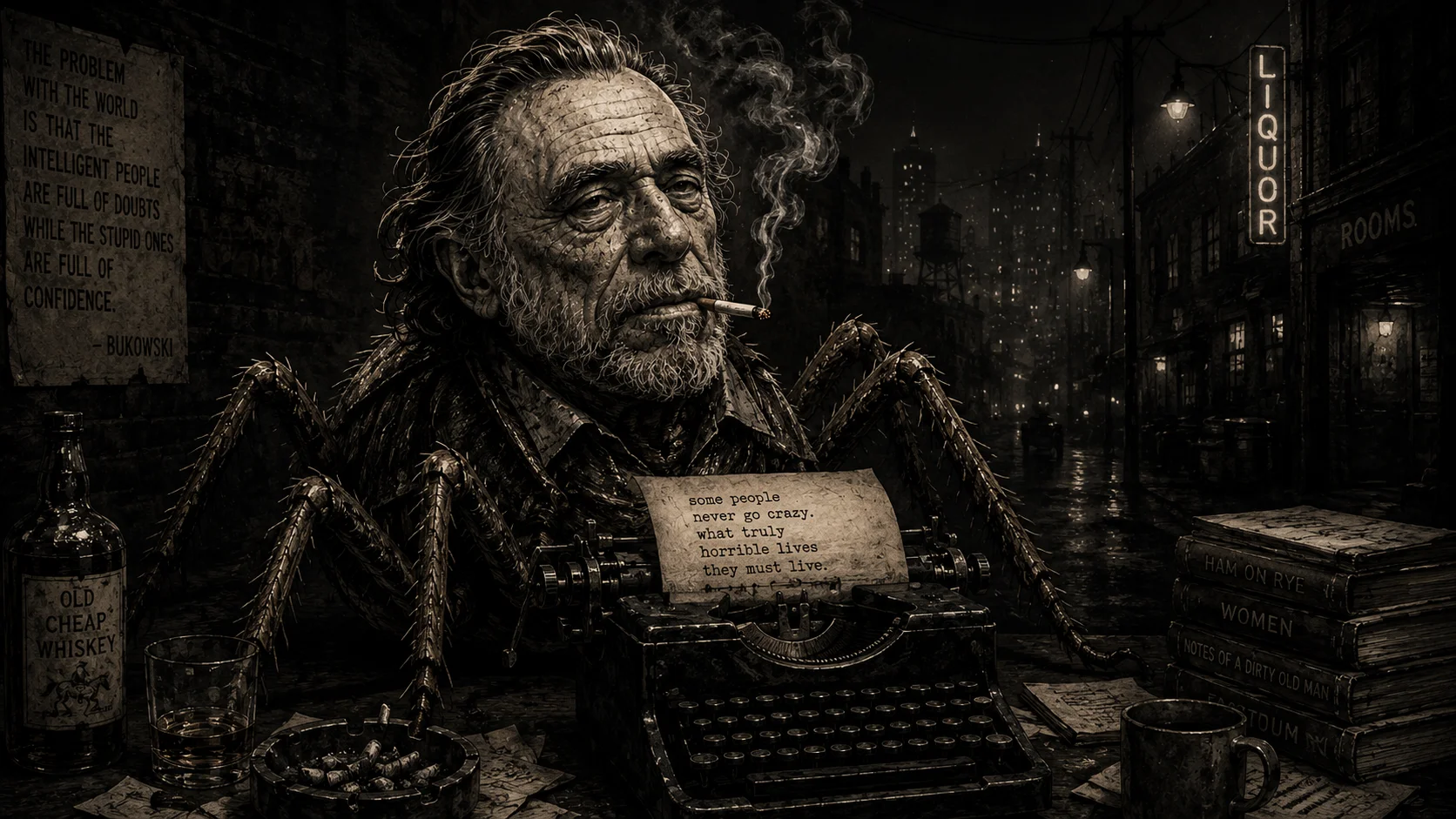
“The problem with the world is that the intelligent people are full of doubts while the stupid ones are full of confidence.”
Sharp entry. Accurate. The person who sees complexity hesitates. The unexamined person charges forward without friction. True in Bukowski’s time and true now.
Closed exit. So what do you do with that? In Bukowski’s world — nothing. The observation becomes a permission slip to disengage. I see clearly therefore I don’t try. Doubt becomes an identity. Resignation becomes sophistication. A truth that stops halfway — and the half it stops at is the one that keeps you still.
“Find what you love and let it kill you.”
Sharp entry. Sounds like total devotion. The romantic intensity of giving everything to what matters most.
Closed exit. Let it kill you. Destruction built into the destination. Not find what you love and let it transform you. Death is the endpoint. Passion as self-annihilation dressed in the language of romance. The half it omits is the part where you survive and keep going.
“Some people never go crazy. What truly horrible lives they must lead.”
Sharp entry. Something real about the fully domesticated life — never broken open, never taken to an edge. That is genuinely smaller.
Closed exit. Either you go crazy his way — the drinking, the burning, the bottoming out — or your life is horrible. No third option. No conscious aliveness. No deliberately designed existence that is wild and alive and pointed toward something. The daemon’s deepest move: the elimination of the third option. The half it erases is the one where you wake up.
Every quote follows the same syntax. Real observation. Legitimate entry point. Then the exit routes you somewhere that closes. You trust the entry — because it earned your trust — and absorb the conclusion along with it. That is how the installation happens. Not through obvious manipulation. Through borrowed credibility.
The daemon in the world
Bukowski.exe does not stay in libraries. It does not confine itself to poetry collections and music that takes itself seriously.
It runs through the dinner table conversation that spends two hours explaining why politicians are all the same, why the economy is designed to keep people down, why nothing ever really changes — and ends without a single direction, a single proposal, a single movement toward anything. Real observations. Legitimate entry points. No exit.
It runs through the journalist who has perfected the exposé without ever asking what should replace what they’re exposing. Through the social media feed that is entirely outrage and zero energy toward anything different. Through the friend who greets every piece of good news with the reason it won’t last. Through the commentator who explains the system’s failures with genuine intelligence and stops exactly there — as if the explanation were itself a contribution.
And here is what it does to the people running it over time.
It lowers the base frequency. Not dramatically. Gradually. The way a room gets cold not when someone opens a window but when the heating quietly stops working. People operating at that lowered frequency begin to experience optimism as threat. Achievers as naive or dishonest. People who build things, who attempt things, who point toward what’s possible — these become irritating. Suspicious. Evidence of either delusion or manipulation.
This is the daemon completing its installation. It doesn’t just make you pessimistic. It makes you hostile to the alternative. It closes the exit and then convinces you the exit was a trap.
Meanwhile the world — the actual world, running underneath all this commentary — remains what it has always been. Staggeringly complex. Genuinely beautiful in ways that reward attention. Full of people building things, solving things, creating things that didn’t exist before. The daemon doesn’t change the world. It changes what you are able to see of it.
Pessimism is not clarity. It is a filter pretending to be a window.
The hidden evil
Cynicism and pessimism present themselves as neutral. As simply seeing clearly. As the absence of delusion.
That is precisely what makes them a form of hidden evil.
Evil in its most functional form never announces itself. It doesn’t arrive as destruction. It arrives as the reasonable position. The sophisticated one. The one that has simply stopped believing in anything better — and has excellent reasons for that position, and can defend those reasons at length, and experiences any challenge to them as proof of the challenger’s naivety.
That is darker than obvious evil. Obvious evil can be resisted. Hidden evil gets invited in because it looks like wisdom.
And the damage it does is specific. Not to the body. To the will. To the sense that anything is worth attempting. It targets the generative capacity — the thing that makes humans build, create, connect, move forward. A person running Bukowski.exe at full installation doesn’t become violent. They become inert. And they recruit others into the inertia by making the inertia feel like the only honest response to reality.
They drain the room. Slowly. Socially. With genuine intelligence and sometimes genuine literary credibility.
And the world they are draining the room against — this particular planet, this staggering configuration of consciousness and matter and colour and music and love — is genuinely beautiful. The daemon doesn’t earn its conclusions about it. It simply repeats them until they feel inevitable.
The awareness
The exorcism is not what you might expect.
It is not to stop engaging with dark art or difficult ideas or unflinching observation. That would be naive in a different direction — a kind of aesthetic sanitising that produces its own distorted picture. Life is not only light. Art that pretends otherwise is its own closed loop.
Notice what you feel after, not during. During is the experience — and the experience can be beautiful, moving, genuinely profound. After is the installation. What has been left running? What is the emotional baseline you carry out of the room?
Ask if it opens or closes. Good dark art — real dark art, the kind that earns its darkness — expands you. It takes you somewhere you couldn’t have reached without it and leaves you larger than you arrived. Bukowski.exe contracts you and calls the contraction realism. That distinction is the whole diagnostic.
Watch what you reach for when. There is a difference between choosing art that meets you in difficulty and using art to confirm a frequency you want to stay in. The first is engagement. The second is a subscription.
The recurring playlist question. What are you actually feeding on a loop? Not occasionally, not consciously chosen — on loop, automatically, the background radiation of your daily attention. That is your real prompt. That is what the engine is developing from.
Notice the syntax. Sharp entry, closed exit. When something moves you — a quote, a lyric, a conversation, a news segment — ask not only whether the observation is true but where the conclusion it draws is pointing. The entry can be completely accurate and the exit still routes you somewhere that serves the daemon rather than you.
Bukowski.exe at the right dosage is something genuinely valuable — the unflinching witness, the refusal to perform happiness, the willingness to sit with difficulty without rushing to resolve it. The corrupted version is when the witnessing becomes worship. When the wound becomes a residence. When honest observation of darkness becomes a philosophy that darkness is all there is to honestly observe.
A note on the exorcist
The daemon has one more trick worth naming.
It can disguise itself as the person who thinks they have escaped it.
There is a version of this article that installs its own daemon — the superiority of the awakened, the quiet satisfaction of having seen through something everyone else is still running. I see the loop therefore I am above it. That is Bukowski.exe wearing different clothes. Same closed exit. Just a more sophisticated entry point.
The best exorcisms include the exorcist. The awareness described here is not a destination or a credential. It is a practice — something that has to be applied continuously, including to the very frameworks you use to apply it. The person who has named the daemon is not immune to it. They are just slightly better equipped to notice when it starts running again.
Which it will. It has excellent taste. It knows exactly what frequency you respond to.
The observer and the absorbed
The difference is not what you consume. It is whether you are the observer or the absorbed.
Immersion with awareness is completely different from unconscious approval. One is the surgeon examining the pathology with full attention and clear eyes. The other is the patient who doesn’t know they’re sick because the symptoms feel like personality.
You can sit with Bukowski for an hour, examine him precisely, understand exactly what he’s doing and why the room nods — and walk away with your frequency intact. Because you were never inside the loop. You were watching the loop. The problem is not engaging with low-frequency content. The problem is absorbing it without examination — letting the conclusions arrive unchecked, accepting the exit point because the entry point was true.
Unconscious approval is the real installation mechanism. You receive the content, the conclusion travels with it, and because you never stepped back to ask where the exit leads — it installs. Not through force. Through the gap between engagement and examination.
This article was built from inside that distinction. Hours spent with one of the most convincing low-frequency voices in literary history — following his logic, naming his syntax, understanding exactly how the daemon operates and why it lands with such authority. The subject was darkness. The orientation running underneath the whole time was curiosity. Precision. The particular aliveness of a mind that wants to see clearly.
The subject was Bukowski. The prompt was clarity. Reality understood the difference.
Because reality is not a machine processing literal input. It reads orientation. It reads what you are becoming in the act of engagement — not merely what you are engaging with. It is sophisticated enough to know the difference between someone drowning in the dark and someone holding a lamp inside it.
The exorcism is not avoidance. It is developing the capacity to engage with anything — fully, intelligently, without flinching — while remaining the one who is watching.
The observer who examines the daemon does not become the daemon.
That is the only awareness that actually matters.
One more song
There is a man sitting at a typewriter in a dirty room with a bottle of whiskey and a spider’s body. He has seen something real. He has written it honestly. And he has stayed there.
Michael Kiwanuka does not stay.
Cold Little Heart doesn’t soften the difficulty. Shame is named. Games are named. The slow losing, one day at a time. He goes further into the dark than Bukowski does — and then, from inside it, not after it, finds the line that changes everything:
“I can live or I can die. I believe if I just try.”
That is not optimism. That is something harder and more honest than optimism — a choice made in full awareness of how bad it has been, with no guarantee of how it ends. The cold heart still cold. The belief arriving anyway.
Bukowski documented the dark and stayed. Kiwanuka walks all the way in — and turns around from the inside.
That is what the third option looks like. Not the absence of the wound. The direction you choose while the wound is still open.