
What ancient ritual and neuroscience are actually telling us about the human mind
There is a persistent cultural assumption that the person who spends their weekend in a dark room listening to repetitive music is doing something to their brain that the person attending a lecture or reading serious literature is not. That the serious pursuits build cognitive capacity and the hedonistic ones drain it. This assumption is wrong in ways that are now measurable.
Start with what trance-inducing music actually does to the brain over time, not just during the experience.
Repeated exposure to complex rhythmic structures — and electronic music at its serious end is genuinely complex, built from layered polyrhythmic patterns, microtonal variations, frequency relationships that the conscious mind doesn’t track but the auditory cortex absolutely does — develops what neuroscientists call auditory scene analysis. The brain becomes better at parsing multiple simultaneous streams of information, distinguishing signal from noise, tracking patterns across time. This is not a minor skill. It underlies reading comprehension, language acquisition, mathematical reasoning, and the ability to follow complex argument. Musicians consistently outperform non-musicians on tests of working memory, attention, and processing speed. The mechanism is the same regardless of whether the music is a Bach cantata or a four-hour techno set. The brain is being trained.
The altered state itself does additional work. When default mode network activity drops — when the self-referential chatter quiets — the brain doesn’t go idle. It enters a state associated with what researchers call insight processing. The connections that form during reduced DMN activity are often between regions that don’t communicate much during ordinary focused thought. This is why solutions to problems that seemed intractable sometimes arrive during meditation, in the shower, or after an experience that genuinely shifted your state. The brain, released from its normal editorial constraints, makes unusual combinations. Some of them are useful.
Regular practitioners of genuine trance states — meditators, people with serious long-term engagement with music and dance as altered-state practices — show measurable structural differences in the brain. Increased grey matter density in regions associated with attention and sensory processing. Greater connectivity between prefrontal and limbic regions, meaning better integration between cognition and emotion. Thicker cortical regions associated with interoception — the ability to read your own internal states accurately. That last one matters more than it sounds. People who can accurately read their own internal states make better decisions, have more stable emotional regulation, and are significantly less susceptible to manipulation through emotional arousal. They know what they’re actually feeling, which turns out to be rare.
The psychological dimension runs alongside the biological one and is less easily measured but no less real.
Ego dissolution — even partial, even temporary — is cognitively disruptive in a productive way. The ordinary mind runs on a set of largely unexamined assumptions about who it is, what it values, what the world is like, and what’s possible. These assumptions are useful for daily functioning. They are also, frequently, wrong, outdated, or imported wholesale from the environment without ever being chosen. An experience that temporarily suspends the machinery maintaining those assumptions creates a window. Not a guarantee of insight, but an opening.
People who regularly create these openings — through music, through dance, through genuine immersion in altered states rather than the simulation of them — tend to have a more fluid relationship with their own beliefs. They are more able to hold contradictory ideas without distress, more able to update when evidence changes, more able to separate their identity from their opinions. These are not spiritual outcomes. They are cognitive ones. They show up in how people reason, not just in how they feel.
The person who has spent years moving between ordinary consciousness and genuinely altered states and back again has, in a specific sense, more experience of consciousness itself than someone who has stayed in one mode continuously. They know their mind from more angles. They have observed their own narrative machinery from outside it, even briefly, enough times to be less completely captured by it.
This is a form of intelligence that does not show up on any standardised test and is not rewarded by any credentialing system. It is also not evenly distributed. It accrues to people who took the music seriously, who went deep enough and often enough, who didn’t mistake the aesthetic for the experience. It does not accrue to people who attended festivals primarily for the photos, or who spent their nights in bars where the music was too incoherent to entrain anything, or who consumed substances without any practice or intention around the state they were inducing.
The provocation, stated plainly: a person who has spent a decade genuinely engaging with music as a technology — who has followed rhythm into states their ordinary mind cannot reach, regularly, with some degree of seriousness — has developed cognitive and emotional capacities that are not available to someone who has not. Not because they are inherently more intelligent. Because they have been training something, whether they used that word or not, that the other person has not.
The ancient traditions understood this. That is why the ritual was not optional. That is why the drummer, the chantor, the one who held the rhythm, occupied a specific role in the community that was not interchangeable with other roles. The person who knew how to move between states of mind and return coherently had something to offer that the person who had never left their ordinary mind did not.
We mostly lost the vocabulary for this. The experience kept happening. The understanding of what it builds, over time, in a person who takes it seriously — that is worth recovering.
Sound before everything
Before the warehouse, before the church, before the concert hall — there were two sticks hitting each other.
That is where this starts. Percussive rhythm is the oldest human technology for altering consciousness. Not fire, not language, not agriculture. The drum. Archaeological evidence of ritual percussion predates written history by tens of thousands of years. Every civilisation that developed independently arrived at the same conclusion: organised sound, sustained and repetitive, does something to the human nervous system that nothing else quite replicates.
The progression from there is a straight line. Two sticks become a stretched hide. A hide becomes a tuned instrument. Tuned instruments coordinate into ensemble. Ensemble develops into structured music with internal logic — tension, release, anticipation, resolution. Each step increases the precision with which the technology can target the nervous system.
What runs through all of it, across every culture that took sound seriously, is a shared intuition: certain frequencies, certain patterns, certain sustained tones access something that ordinary life does not. This was not treated as aesthetic preference. It was treated as technology. Sound as a tool for reaching altered states, for communicating with what humans variously called gods, spirits, ancestors, or the deeper structure of things.
The evidence is everywhere and consistent. Gregorian chant works through sustained resonance in a reverberant stone space — the architecture is part of the instrument.
Tibetan singing bowls are tuned to specific frequencies believed to correspond to states of consciousness. Hindu and Buddhist mantra practice uses vowel sounds that create physical vibration in the skull, chest and sinus cavities. The Islamic call to prayer is structured to arrest ordinary cognition and redirect attention.
Sufi sama uses music explicitly as a vehicle for dissolution of the individual self. Indigenous drumming traditions across five continents converge on rhythmic patterns in the theta frequency range — four to eight beats per second — which corresponds directly to theta brainwave activity associated with deep meditation, hypnagogic states, and what neuroscience now calls reduced default mode network activity.
They didn’t have fMRI machines. They had ten thousand years of empirical observation about what sound does to a person.
The mantra specifically is worth understanding on its own terms. It is not lyrics. It is not a message to be decoded. A mantra is a sound object, used repetitively, whose function is to occupy the linguistic and analytical mind just enough to quiet it — while the repetition itself induces the neural state the practitioner is after. Om is not a word. It is a vibration that, when sustained, resonates in specific cavities of the body and entrains specific neural rhythms. The Sanskrit tradition was explicit about this: the sound itself is the mechanism, not the meaning.
Which makes what currently passes for conscious music particularly worth examining.
Festival stages and wellness playlists are full of it. Songs built on the aesthetic shell of spiritual music — world instruments, minor keys, breathy vocals — but carrying lyrics that function as affirmations, personal growth slogans, lifestyle philosophy. I am infinite. Rise and expand. We are one. The production signals depth. The content is a self-help caption set to a Hang drum.
This matters because it inverts the mechanism entirely. Real mantra empties the analytical mind by giving it a sound object that doesn’t require interpretation. Pseudo-spiritual lyrics do the opposite — they engage the analytical mind, ask it to process meaning, nod along, agree or disagree, feel validated. The listener stays firmly in their head, now with the additional sensation of having been somewhere profound. It is the neurological equivalent of reading a menu instead of eating.
The music that actually does what ancient sound practices did tends to have almost no lyrics at all. Or uses the voice as an instrument — texture, not text. This is not coincidence. Minimalist techno, drone, certain ambient music, specific strains of electronic composition — these work on the nervous system through the same pathways the ancient traditions were using. Not because the producers studied ethnomusicology, though some did. Because when you pursue the question of what sound actually does to a person and follow it honestly, you end up in similar territory.
Two wooden sticks, ten thousand years ago. A Roland 808 in a Chicago basement, 1977. Different tools, same question, same target.
Strip the mysticism
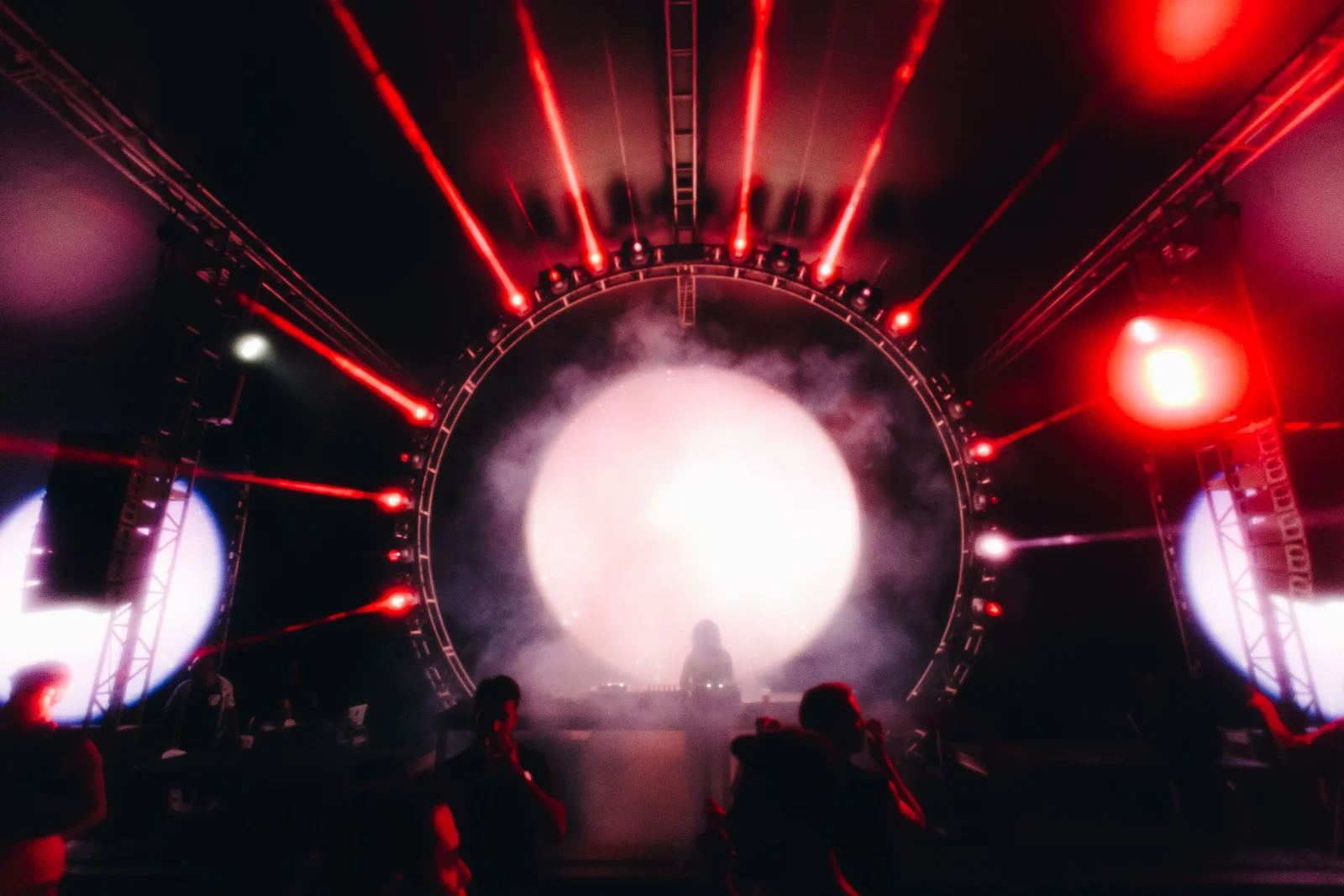
Here is what actually happens. You move your body for hours. Heart rate climbs. You sweat through your shirt. A few hundred or thousand people around you are doing the exact same thing, locked to the same pulse. The bass doesn’t come through speakers so much as through the floor, your ribs, the back of your teeth. Lights are calibrated to disorient. By 4am the part of your brain that tracks social standing, personal narrative, what you owe and who you are has largely switched off.
You feel, as people reliably report, something close to transcendence.
The usual move here is to reach for religious metaphor. But metaphor explains nothing. The more useful question is mechanical: what is the body actually doing, and why does it reliably produce that particular feeling?
The six levers
Every culture that has produced this kind of ritual — and every culture has — is working with the same biological hardware. There are six inputs. Pull enough of them hard enough and the output is consistent: reduced self-consciousness, heightened social connection, altered perception, a felt sense of significance that lingers after.
Sustained movement. Hours of rhythmic physical effort floods the system with endorphins and endocannabinoids. These are the same molecules behind runner’s high — not a metaphor, the same chemical pathway. Sustained movement also suppresses the brain’s self-referential circuits. The internal monologue quiets. You stop narrating and start experiencing.
Elevated heart rate and heat. A packed room of moving bodies runs hot. Cardiovascular exertion shifts neurochemistry toward alertness and presence. The body registers intensity, continues moving, then signals safety — producing a kind of earned calm inside the chaos that people find difficult to describe but instantly recognise.
Sound structured for the body. Repetitive rhythm synchronises neural oscillations. Low-frequency bass vibrates tissue directly. The architecture of electronic music — long builds, delayed resolution, the drop — exploits prediction and reward circuits. Anticipation, tension, release, repeat. Dopamine responds to this reliably. It is one of the most effective non-chemical dopamine triggers identified by neuroscience.
Sensory environment. Darkness removes social legibility. Clothes, age, and markers of status blur. Sensory overload in one channel (sound) combined with reduction in another (visual clarity) destabilises normal cognitive processing. The brain, unable to run its usual interpretive routines, shifts into a different mode.
Other people moving in sync. Coordinated physical movement with others releases oxytocin. This is measurable, not poetic. Humans marching together, rowing together, singing together, dancing together — the mechanism is the same. Synchronised bodies produce social bonding chemistry. The warmth felt toward strangers on a dancefloor is not imagined. It is produced.
Substances. Some amplify serotonin. Some directly suppress the self-referential brain regions that movement was already quieting. Some modulate the endocannabinoid system that rhythm had already engaged. None are required — the other five levers produce the same output more slowly — but they compress the timeline and intensify the result.
This is not new
The warehouse, the strobe, the 140 BPM kick — these are recent. The underlying method is not.
Every documented human civilisation independently developed a version of this. West African drumming ceremonies running through the night, possession states deliberately induced. Ancient Greek Dionysian rites: wine, music, group movement, the temporary suspension of the normal social order. Sufi practice: repetitive movement and chant used to dissolve the individual self into something larger. Indigenous ceremonies across the Americas combining heat, rhythm, plant medicine and darkness. South Asian temple traditions where the body itself is the primary instrument. Medieval Christian flagellant processions, Norse seiðr, Haitian Vodou, Siberian shamanic drumming.
The specific deity differs. The cultural meaning differs. The input stack does not.
Everyone, everywhere, working with the same nervous system, converged on the same approximate solution: move together, loudly, in conditions that suppress normal social cognition, for long enough that the brain shifts state. What we call a rave is this same technology running on post-industrial infrastructure. Different enclosure, same machine.
Why it feels significant
When the self-narrative quiets — when the circuit that monitors how you appear, what you owe, and where you stand temporarily goes offline — what remains is closer to raw sensory and social experience without the usual editorial layer. This state is reliably described by humans as profound. That may not be a misinterpretation. It may be that the ordinary waking state, heavily curated by exactly the systems that just went quiet, is the less accurate one.
The limbic system is also consolidating memory differently during intense emotional states. Euphoria, panic, overwhelming connection — the brain flags these as significant and encodes them deeply. The felt importance of the experience is not confabulation. It is the brain correctly registering that something unusual and potentially relevant to the organism just occurred.
This is why people describe both religious experiences and good nights out in the same language: life-changing, clarifying, a before and after. The neurological process is similar enough that the language converges.
What got lost in translation
At some point the container got separated from the contents.
The nightlife industry looked at what was happening in basements and warehouses and correctly identified that people wanted it badly enough to pay for it. So it built a version that could scale and charge admission. Better lighting rigs. Resident DJs with Instagram followings. Bottle service. Queues managed by people whose job is to make the queue feel like proof of something. The music selected not for what it does to a nervous system over four hours but for what keeps people at the bar ordering another round.
What emerged is a simulacrum that shares the address but not the function.
Bar culture as it now exists in most cities runs on a different logic entirely. The music is loud enough to prevent conversation but not structured to induce anything. It is sonic wallpaper with a tempo. The social dynamic is oriented around display — who you’re with, what you’re wearing, whether the right people can see you — which is precisely the opposite of what the original technology required. The ancient ritual worked by suspending the social self. The modern night out is organised around performing it.
The substances changed function too. Alcohol in quantity is a social lubricant and then a sedative. It doesn’t open anything, it numbs. The drug culture that developed around commercialised nightlife often follows the same logic — stimulants to stay alert enough to keep spending, nothing that would actually shift perception in a direction that costs the venue money. You can’t sell six-hour experiences in forty-five minute table slots.
The economics are straightforwardly hostile to the original conditions. Darkness is cheap. Long-form repetitive music that builds slowly requires an audience willing to stay and follow — that audience doesn’t turn over fast enough. Anonymity is bad for brand recognition. Ego dissolution is not a purchasable add-on.
So what gets sold instead is the aesthetic residue. The feeling of being somewhere important. Association with music that was once connected to something real, now licensed and repackaged. The social proof of the queue, the wristband, the photo. The hangover without the experience that would have made it worth it.
The festival problem
The commercial nightlife critique is at least honest about what it is. The festival industry is more interesting because it genuinely believes its own marketing.
Somewhere in the mid-2000s the festival became a vehicle for self-concept rather than experience. Coachella turned a music event into a content opportunity. What people took home was not a shift in perception but a verified aesthetic identity — the photos, the outfits, the presence at something culturally legible. The music is secondary to the evidence of having been there. Lineups are announced and debated months before anyone hears a note in that environment. It is music as social currency, not music as technology.
Burning Man sits in its own category because it actively markets itself as the other thing. Ten principles. Radical self-reliance. Gifting economy. Decommodification. The language borrows directly from genuine transformative traditions and presents the event as their contemporary heir. And for some people, in some years, it delivers something real. The desert environment, the scale, the sensory assault, the permission structure — these can genuinely pull the right levers.
But Burning Man is also, now, a place where a significant portion of attendees arrive on private jets, sleep in air-conditioned structures staffed by hired help, and leave before the dust gets too thick. The gifting economy operates alongside a shadow economy of exclusive camps with full catering. The decommodification principle sits next to brand activations and influencer documentation. This is not a cynical observation — it is what happens when a ritual form gets aspirational enough to attract people whose primary relationship to experience is acquiring it.
The deeper problem with festival culture broadly is one of duration and structure. Most festivals run on a schedule. Stages, set times, headliners, support acts. You move between them. The experience is curated for you in advance by bookers whose job is to maximise perceived value across the widest possible audience. This is not how the ancient technology works. It works through sustained immersion — one environment, one pulse, long enough for the brain to actually shift. A forty-five minute set by a recognisable name, sandwiched between two others, consumed by a crowd simultaneously filming it, does not produce the same output. It produces the sensation of having been in proximity to something that once produced that output.
The festival crowd is also, structurally, a daytime crowd. The conditions that matter — darkness, anonymity, the particular quality of 3am — are not the conditions of a field in the afternoon sun with phone signal and food vendors and a clear route back to your tent. These are pleasant things. They do not create the state being discussed.
This is not snobbery about production scale or genre. A well-run underground event can fail to produce anything, and a festival stage can occasionally deliver something genuine. But the conditions that produce genuine altered states are specific and mostly incompatible with the product that festival economics require. The festival optimises for attendance, documentation, and return visit. The ritual optimises for dissolution of the self. These are not the same project.
What this actually means
Understanding the mechanism doesn’t flatten the experience. Knowing that a fever is an immune response doesn’t make being ill less real. The experience is the experience. The mechanism explains how it works, not whether it matters.
What the mechanism does do is remove the need to treat this as accidental or subcultural or modern. It is none of those things. The capacity to produce altered states through rhythm, movement, darkness, and collective presence is species-wide and ancient. It has been independently discovered on every continent. It predates agriculture, cities, and written language.
The specific technology updates. The underlying call and response between nervous system and ritual environment does not.
The people walking out at dawn, quiet in a particular way — they ran an old programme. It worked the way it always has. Whether they have language for what happened or not changes nothing about the fact that it did.
The people who paid four hundred euros for a festival wristband and left with good photos had a different experience entirely. Not necessarily a bad one. Just a different product, with different outputs, using a similar vocabulary.
Knowing which one you are attending seems like the minimum useful orientation.