
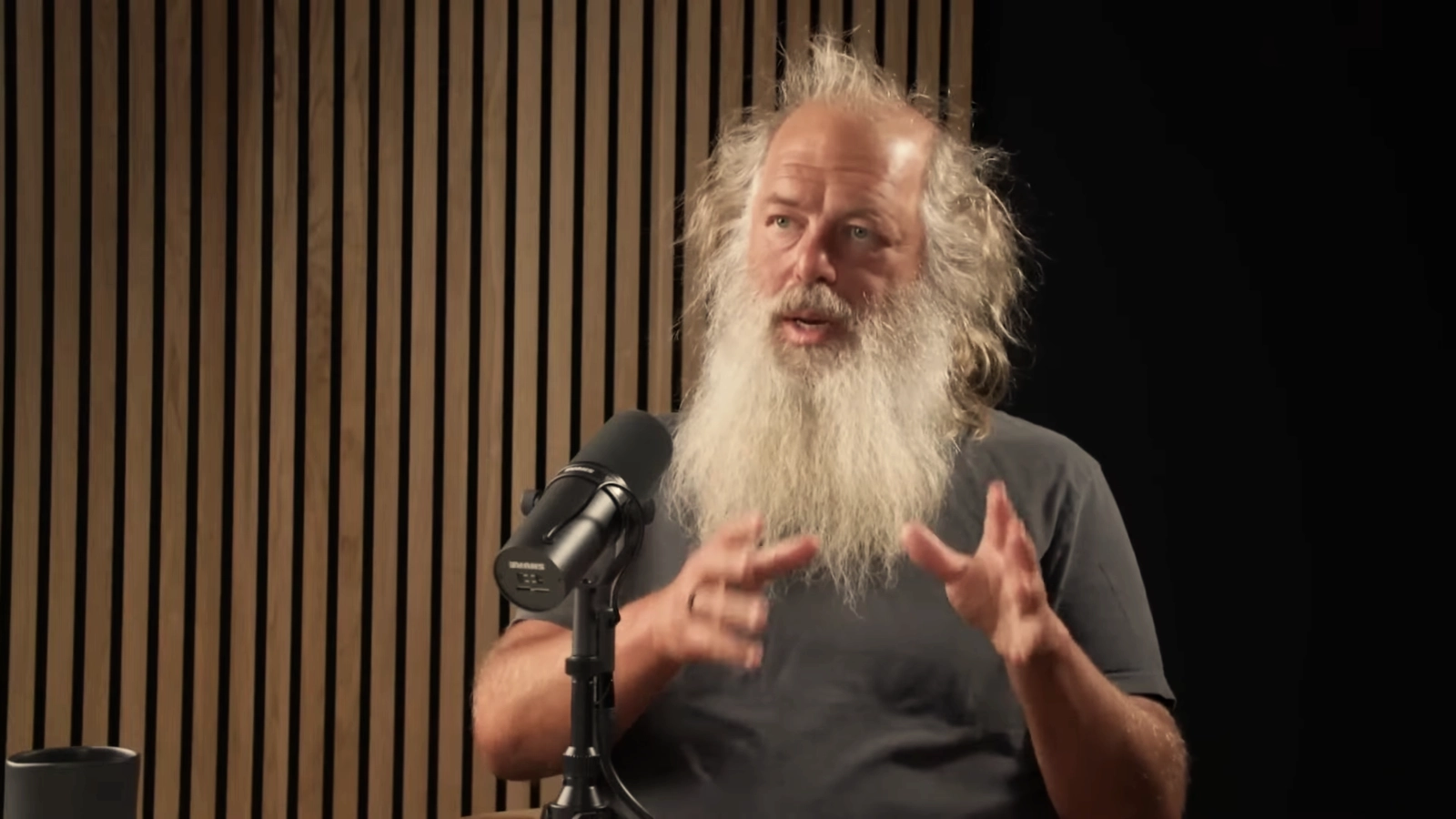
He has produced some of the most important records of the last forty years — for Metallica, Johnny Cash, the Red Hot Chili Peppers, Jay-Z, Adele, and dozens more. Yet artists who have worked with him often struggle to explain what he actually does. The answer might be the most important thing any creative person could learn.
There is no mixing console in the room. No guitar in his hands. No headphones, no track sheets, no engineering station covered in faders and knobs. Rick Rubin sits, usually barefoot, often in silence, and he listens. Not to the recording — to the artist. To what they’re afraid of. To what they’re hiding. To the gap between what they’re making and what they actually have inside them.
That is, in the most honest possible description, what Rick Rubin does. And it has made him the most consequential music producer of his era.
One man’s name appears, quietly, in the credits of an improbable number of the songs that changed you.
He has worked across hip-hop, heavy metal, punk, country, alt-rock, pop, R&B, and folk. He has helped first albums find their shape and late-career records find their soul. He turned a forgotten country legend into a cultural monument. He helped a band remember who they were after years of trying to be someone else. He has produced records that won Grammys, records that changed genres, records that people return to thirty years later and still find alive.
And through all of it, his method has been strikingly, almost stubbornly consistent: strip everything away until only the truth remains.
What he actually does
A persistent misconception places Rubin at a mixing console, crafting sounds all day. This is not what he does. Rubin himself has called his role closer to that of a coach, or a creative editor — someone who shapes the conditions in which great work can emerge rather than technically constructing the work itself.
“I never decide if an idea is good or bad until I try it. So much of what gets in the way of things being good is thinking that we know.” — Rick Rubin
In practice, his role involves choosing which songs make the final record, challenging weak or dishonest material, encouraging artists to simplify arrangements that have become cluttered, identifying what is most emotionally true in a performance, and — perhaps most critically — protecting the artist’s core identity from the pressures of the market, the label, and their own self-doubt.
- Choosing which songs make the album
- Challenging weak or dishonest material
- Encouraging artists to simplify
- Identifying what is most emotionally compelling
- Protecting the artist’s core identity
- Asking the question that unlocks everything else
This is why artists from radically different worlds — thrash metal, hip-hop, acoustic country, arena rock — have all sought his involvement. His skill is not genre-specific. It is not even music-specific. It is the skill of attention, applied with unusual precision and unusual courage.
“If you really listen to what people say, usually they tell you everything.” — Rick Rubin
The scope of a career
Before going deeper into the philosophy, it helps to understand the sheer breadth of the catalog. The range is not incidental — it is the point. Rubin’s ability to function across every corner of popular music is the clearest evidence that his method is about something more fundamental than sound.
- Hip-Hop: LL Cool J · Beastie Boys · Run-DMC · Public Enemy · Jay-Z · Eminem · Kanye West
- Metal & Hard Rock: Slayer · Metallica · System of a Down · Rage Against the Machine · Linkin Park · Black Sabbath
- Rock & Alternative: Red Hot Chili Peppers · Tom Petty · The Strokes · Weezer · Aerosmith · Neil Young
- Country & Folk: Johnny Cash · The Chicks · Sheryl Crow · Lucinda Williams · Neil Diamond
- Pop & R&B: Adele · Lady Gaga · Ed Sheeran · Lana Del Rey · Shakira · Lorde
These are not different phases of a career. They are concurrent, overlapping, simultaneous. Rubin moved between them without repositioning himself, without adapting his identity to fit the genre. He brought the same orientation to Slayer’s Reign in Blood as he would later bring to Adele’s 30: a deep patience, a willingness to ask what the work is actually trying to say, and the confidence to protect the answer once found.
The dorm room that changed music
He was twenty-one years old and studying at NYU when he co-founded Def Jam Recordings with Russell Simmons from a dorm room in 1984. Hip-hop at that moment was still considered a local novelty — a street form, a party form, certainly not the dominant cultural language it would become. Major labels saw a trend. Rubin heard a transformation.
LL Cool J, Beastie Boys, Public Enemy. He did not manufacture those artists. He recognized them, created infrastructure around them, and trusted what he heard over what industry consensus said was viable. That instinct — trust the music, ignore the noise — would define everything that followed.
“I’ve always been an outsider. When I did magic, I was the only kid. When I worked with Johnny Cash, I was completely out of place in Nashville. And when I started Def Jam, I was the only white guy in the hip-hop world.” — Rick Rubin
The outsider position was not incidental. It was, arguably, the source of his power. He listened without the filters that industry insiders had accumulated. He heard things that proximity had made invisible to everyone else.
Metallica: the question of identity
By 2006, Metallica had spent the better part of a decade not quite knowing who they were. The band that had defined thrash metal — that had made Ride the Lightning and Master of Puppets, two albums that sounded like controlled fission — had wandered through radio experiments, an orchestra collaboration, a therapy documentary, and St. Anger, an album with no guitar solos and a snare drum that became a running joke among their most devoted listeners. These fans were not merely disappointed. Something closer to grief had entered the relationship.
Rubin’s question when he entered the process for Death Magnetic was characteristically direct: who are you when you are most yourself? Not: who were you? Not: who does the market want you to be? He reportedly encouraged the band to reconnect with the qualities that had made their classic records so powerful — longer compositions, real guitar solos, that particular density and darkness that was native Metallica language.
He did not want them to go back. He wanted them to go deeper. The result was an album that felt, for the first time in years, like Metallica had stopped performing an idea of themselves and started inhabiting it again.
The lesson is more broadly applicable than it first appears. Identity is not a cage. Returning to your essential nature is not a retreat. In a culture that treats constant reinvention as a virtue, Rubin’s work with Metallica is a quiet argument that knowing who you are is itself a form of creative courage.
The Red Hot Chili Peppers and the mansion on Laurel Canyon
When Rubin took the Red Hot Chili Peppers into a rented mansion in Los Angeles to record Blood Sugar Sex Magik in 1991, he was making an environmental argument before he said a word about music. The band lived in the house. They recorded in it, slept in it, moved through its rooms at three in the morning when songs wouldn’t come and then came all at once. The environment was the first instruction.
The album that emerged was explosive in places — “Give It Away” crackled with the band’s kinetic funk-punk energy. But what Rubin had quietly drawn out was something more surprising: emotional depth. Anthony Kiedis wrote “Under the Bridge” alone with an acoustic guitar, a song about loneliness so specific and unguarded it made him uncomfortable to share it. Rubin heard it and insisted it go on the record. The band was uncertain. The song became one of the defining rock tracks of its era.
Nearly a decade later came Californication — the reunion with guitarist John Frusciante, the pivot toward melody and space and something approaching melancholy. Rubin helped shift the band’s center of gravity away from pure kinetic energy and toward emotional resonance. “Scar Tissue.” “Otherside.” “Californication.” Songs that breathe. Songs that know something about impermanence.
The partnership continued through By the Way and Stadium Arcadium, covering the most commercially and creatively sustained stretch of the band’s existence. What Rubin understood about them — as he understood about all his artists — is that the most interesting creative territory is always adjacent to what the artist thinks they are. The Chili Peppers believed they were a party band. They were also, it turned out, capable of genuine tenderness. Rubin simply created the conditions in which tenderness was allowed to appear.
Johnny Cash: the art of revelation
By the early 1990s, Johnny Cash was considered finished. He was in his sixties, dropped by two major labels, his catalog associated with a version of country that contemporary radio had moved decisively past. He was a monument — the kind of artist people revere and no longer actually listen to.
Rubin signed him to American Recordings with a different question in mind. Not: how do we modernize Johnny Cash? But: what does Johnny Cash most deeply have to say, and what is the least we need around it to let that come through?
The answer, it turned out, was almost nothing. A voice. An acoustic guitar. Silence where silence belonged.
“What I came to realize about the whole Johnny Cash experience was that he was a great storyteller. The song didn’t matter — all that mattered were the words. All that mattered was if the character of Johnny Cash — the mythical Johnny Cash, the Man in Black — would say those words.” — Rick Rubin
The American Recordings series that resulted is now regarded as one of the most remarkable late-career artistic reinventions in popular music history. Cash recorded songs by Beck, Nick Cave, Soundgarden, Depeche Mode, Nine Inch Nails — not as novelty, not as an aging artist chasing relevance, but as testimony.
Written by Cash himself — not a cover, but an original drawn from the Book of Revelation — it sits on the same album as “Hurt” and “Personal Jesus” and outweighs them both in quiet devastation. Rubin hadn’t just found Cash songs to inhabit. He had made him want to write again.
When Cash sang Trent Reznor’s “Hurt,” he inhabited it so completely that Reznor himself said the song no longer felt like his.
The music video, filmed not long before Cash’s death in 2003, is almost unbearable to watch — a man sitting with what a life leaves behind, looking directly at the camera, images of fame and youth decaying around him. It is one of the most honest things ever committed to film.
After Cash’s second album with Rubin won the Grammy for Best Country Album in 1998, country radio had refused to play a single track from it. Rubin took out a full-page ad in Billboard magazine to thank them for their indifference. It remains one of the greatest gestures of creative confidence in music industry history.
“Rick made me have faith in myself again. He made me believe in myself and my music, which I thought was gone forever.” — Johnny Cash
Rubin did not reinvent Johnny Cash. He revealed him. He removed everything that had been placed on top of the man over decades — the expectations, the nostalgia, the category of “country legend” — and found, underneath all of it, something permanent.
Ideas floating through the universe
Rubin’s creative philosophy is not metaphorical. He means it literally. Ideas, in his understanding, exist independently of the people who eventually express them. The artist is not a creator in the conventional sense — not someone who generates something from nothing — but a receiver, an antenna, someone who has developed enough sensitivity and stillness to notice what is already passing through.
“We are all antennae for creative thought. Some transmissions come on strong, others are more faint. If your antenna isn’t sensitively tuned, you’re likely to lose the data in the noise.” — Rick Rubin, The Creative Act
This is not mysticism dressed up as productivity advice. It is a coherent account of how creative attention actually works — one that aligns with what artists, writers, and composers have described across centuries. The experience of receiving rather than constructing. Of discovering something that felt like it was waiting to be found.
“If you have an idea you’re excited about and you don’t bring it to life, it’s not uncommon for the idea to find its voice through another maker. This isn’t because the other artist stole your idea, but because the idea’s time has come.” — Rick Rubin, The Creative Act
Rubin began practicing Transcendental Meditation as a teenager. His doctor, treating stress-related pain in his neck, recommended it. He has practiced daily ever since, and the orientation it cultivates — that particular quality of open, non-grasping attention — runs through everything he does in the studio. You cannot receive if you are too busy transmitting. You cannot hear the artist if you are too busy telling them what to do.
The book: a philosophy made explicit
In 2023, Rubin published The Creative Act: A Way of Being, and the expectation was a memoir. What arrived instead was a philosophical text — structured not as argument but as a series of meditations, fragments that accumulate into a worldview. It became an unlikely bestseller, read far outside music circles by anyone who makes anything for any reason.
Its central claim is both obvious and radical: creativity is not a talent possessed by a few. It is a fundamental mode of human perception — a way of moving through experience available to anyone willing to cultivate the right quality of attention.
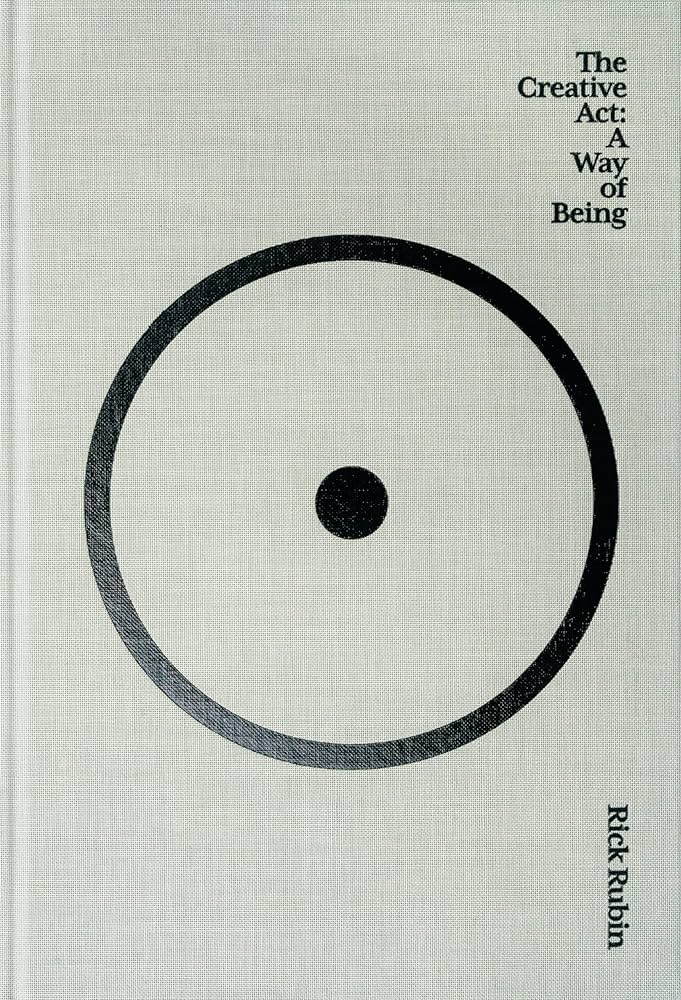
“Living life as an artist is a practice. You are either engaging in the practice or you’re not. It makes no sense to say you’re not good at it. It’s like saying, ‘I’m not good at being a monk.’ You are either living as a monk or you’re not.” — Rick Rubin, The Creative Act
The resonance of the book outside music is not accidental. Rubin’s framework applies to any act of making — design, writing, cooking, building, leading. The obstacles he describes are not genre-specific. Fear of simplicity. Fear of being seen. Fear that what you actually have to say is not enough, or not interesting, or not what the market wants. These are universal obstructions, and Rubin addresses them with the same patience he brings to a struggling artist in a studio.
“All art is a work in progress. It’s helpful to see the piece we’re working on as an experiment. What we create allows us to share glimpses of an inner landscape, one that is beyond our understanding. Art is our portal to the unseen world.” — Rick Rubin, The Creative Act
The philosophy in practice
What does it actually mean to listen the way Rubin listens? He has described it as a practice of removing — not just from the music but from himself. Removing his agenda, his preferences, his assumptions about what the record should be. Arriving, as much as possible, without preconceptions.
“The more that we can remove any baggage we’re carrying with us, and just be in the moment, use our ears, and pay attention to what’s happening — the better.” — Rick Rubin
He pushes artists to put in enormous work — reportedly encouraging bands to record every song fifty times to find its best form, to write a hundred songs in order to find the best fifteen. But the discipline is in service of discovery, not production. The point is not to generate more. It is to find what is real underneath everything that is habitual.
This is the paradox that defines his career. A man who has made some of the loudest, most commercially successful music in modern history became famous for subtraction. For the moment when something unnecessary was taken away. For the silence after the question he asked that nobody else thought to ask.
In a culture obsessed with adding — more content, more noise, more productivity, more strategy — Rick Rubin has spent forty years demonstrating that the rarest and most difficult creative act is knowing what to remove.
“The goal is to live your life in the service of art.” — Rick Rubin, The Creative Act
The artists he has worked with — from a twenty-three-year-old rapper in a dorm hallway to Johnny Cash in the last years of his life — all came looking for something. A producer who could fix their sound. A label that would take a chance on them. Someone who could tell them what to do next.
What they found was someone who listened until they could hear themselves.
The Creative Act: A Way of Being by Rick Rubin (2023) is published by Penguin Press. His podcast, Tetragrammaton, extends the conversations begun in the book. The American Recordings series with Johnny Cash (1994–2010) and the Broken Record podcast with Malcolm Gladwell are essential companion listening.