
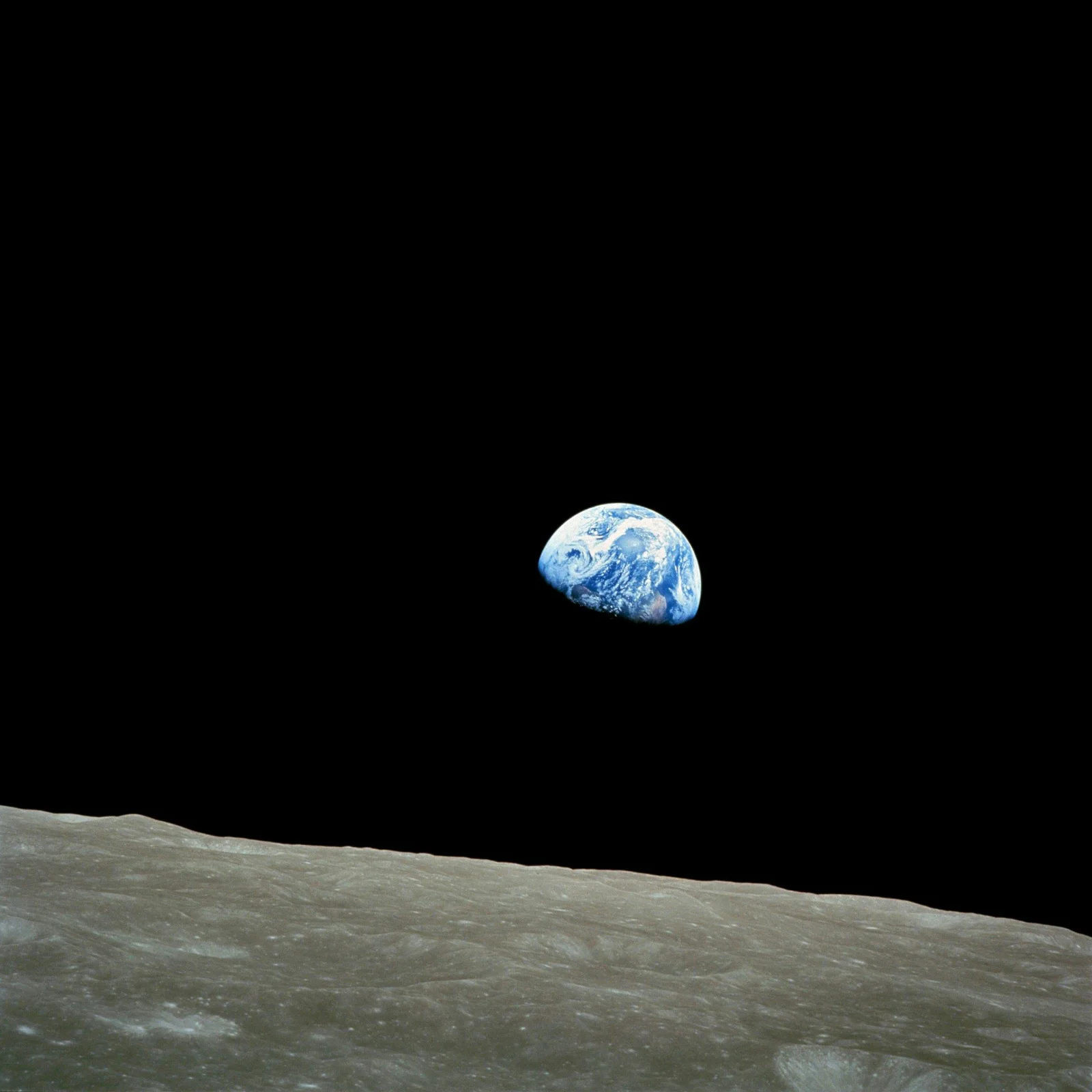

Everything spins.The earth around itself. Around the sun. The sun around the galaxy. The galaxy through something we don’t have a name for yet. Down at the other end of the scale, electrons orbit nuclei in patterns that make the solar system look like a rough draft.
And in between all of that — us. Spinning through our days, our decades, our civilizations. Recycling the same wars, the same wisdom, the same longing to understand what any of this actually is.
Step back far enough and the spinning stops looking like chaos. It starts to look like something composed. Like a design so intricate and so perfectly executed that the only honest response — if you really let it land — is something between awe and laughter and the specific humility of realizing you are both completely insignificant and somehow, impossibly, part of all of it.
That is what this article is about. Not philosophy. Not spirituality. Just a serious look at what is actually here — and what it means to live inside it.
Start with an ant
Not as a symbol. As a fact.
All the computing power of Google, Microsoft, and every major tech company combined could not create an ant. Not mechanically — the whole thing, from the ground up. The DNA folding precisely. The cells differentiating. The nervous system wiring itself. The colony intelligence emerging from thousands of individually simple decisions into something that builds structures underground, farms fungi, wages war, and relocates entire civilizations when the rain comes.
The ant doesn’t know it’s intelligent. It doesn’t need to. The intelligence isn’t located in the ant’s awareness of itself — it’s in the design. The way it fits together. The way the colony fits into the ecosystem, the ecosystem into the watershed, the watershed into a planetary system calibrated with such precision that liquid water is possible, which makes the ant possible, which makes this sentence possible.
Scientists have studied the wing of a mosquito for decades just to produce a rough imitation. A single leaf — its structure for converting light into energy — remains more efficient than anything we have built after a century of trying.
We call all of this biology. Evolution. Natural process. But pause on what those words are actually describing: a system of infinite complexity that has been iterating, improving, and self-organizing for hundreds of millions of years without a single critical failure. From the subatomic to the ecological to the cosmic — every level holds. No bugs. No glitches. Reality doesn’t crash.
The intelligence that isn’t in anyone’s head
We think of intelligence as a brain thing. A human thing. The capacity to solve problems, pass tests, produce correct answers. And so when we look at a rock, we say: not intelligent. When we look at a flower, we say: beautiful, but not intelligent. When we look at the ecosystem that produced the flower — calibrated down to the chemistry of the soil and the frequency of the bees and the angle of the autumn light — we say: nature.
But what exactly is nature doing?
It is running experiments across millions of species simultaneously, learning from every outcome, folding each result into the next iteration. It is solving problems of extraordinary complexity — how do you build a wing that generates lift while weighing almost nothing? how do you design an immune system that can recognize threats it has never seen before? — and solving them elegantly, recursively, at every scale at once.
The philosopher Anaxagoras understood this 2,500 years ago. He called it nous — an infinite intelligence that is “the purest and the thinnest of all things,” that “has power over all things,” that “has all knowledge about everything.” He wasn’t theorizing from an armchair. He was describing something he had looked at directly — the sheer inexplicable fittingness of everything. How it all holds together. How the spin continues without the whole thing flying apart.
Intelligence, properly understood, is not what brains do. It is the order with which creation arranges itself — the field, everywhere, in everything, running the whole operation quietly while we argue about IQ scores.
The pebble on the sidewalk
Pick up a pebble.
Consider: that pebble has an infinite number of causes. The chain of causation that placed it exactly where it is stretches back to the Big Bang — and it isn’t a chain at all, it’s an infinite-dimensional web of forces acting simultaneously. Every atom in the known universe is exerting gravitational influence on that pebble right now. The position of Jupiter matters. The temperature of the air three seconds ago. The footstep that didn’t come.
The pebble is not a simple object. It is a node in a network of incomprehensible complexity, positioned by a process of such precision that no computer we have ever built could model it.
We see a pebble. We keep walking.
This is the problem with familiarity. The extraordinary becomes Tuesday. The commute, the lunch choice, the argument, the small satisfaction of an evening that went well — all of it happening inside the most intricately designed system that has ever existed, and most of us are thinking about whether to take the highway or the side street.
The chess game no one can see
Imagine a chess game played on a board with infinite squares, infinite pieces, in infinite dimensions. Now imagine a player who can see every possible move — not five ahead, not a million, but all of them, simultaneously, from the first move to the last.
That is what produced the ant’s colony. That is what folded the proteins in your hand right now, assigned each hair on your arm its precise angle of emergence, wired the neurons currently making sense of these words.
You are not separate from this. You are a position on an infinite board, shaped by every move that came before you, shaping every move that comes after.
And here is the part that tends to stop people.
You tap into the intelligence. You don’t generate it
When a great artist makes something that genuinely moves people — something that makes a billion strangers feel the same thing at the same moment — they often say the same thing afterward: I didn’t do that. It came through me. The best of it didn’t feel like production. It felt like reception.
I think the force that created us is expressing itself through our existence. I don’t believe that a musical idea starts in your brain — I believe it starts at a place before that, that we don’t have any direct contact with. Everything that we create is nature expressing itself, the same way that when a flower grows out of the ground it’s nature expressing itself.
John Fruiscante
A guitarist named John Frusciante — Red Hot Chili Peppers, one of the most influential players of the last thirty years — sat in an interview and spent the whole thing trying to articulate exactly this. He kept circling it from different angles, getting closer each time. “The force that created us is expressing itself through our existence,” he said, “the same way that when a flower grows out of the ground, it’s nature expressing itself.” And then, more directly: “The idea of somebody considering themselves responsible for a piece of music is ridiculous.” He wasn’t really talking about music.
The scientist who discovers something genuinely new describes something similar. Einstein called his best thinking a kind of listening. Every person who has done something truly great, in any field, and told the truth about how it felt, uses almost the same language.
The human body is, in this sense, the universe’s instrument. The intelligence was never yours to own — it runs through you, the way the spin runs through everything, the way gravity runs through the pebble without asking permission.
Click to read the full interview transcript
John Frusciante
I think the force that created us is expressing itself through our existence. I don’t believe that a musical idea starts in your brain — I believe it starts at a place before that, that we don’t have any direct contact with. Everything that we create is nature expressing itself, the same way that when a flower grows out of the ground it’s nature expressing itself.
Music is an ineffable thing that words can’t really do any good to give us true understanding of. We’re able to make contact with that current — the creative force of the universe, the source, God, whatever you want to call it — by learning a musical language, learning an instrument, learning how to identify a sound and a feeling and gradually express that feeling.
The idea of somebody considering themselves responsible for a piece of music is ridiculous. We’re only acting into the laws of nature that have given us the possibilities we’re exploring with the intelligence we’ve been given. The frequency spectrum from low to high — that’s what we’re working with. It’s there whether we’re here or not, as part of the structure of physical reality. The 12-note scale was just something waiting to be discovered, which was already a mathematical possibility before Pythagoras thought of it.
The star-making machine of Hollywood has perpetuated a lie — that the image is the thing, that the person’s name and physical appearance is responsible for the creation of what they do. It’s not. What creates it is the imagination. And there’s no way to quantify the imagination, no way to sell it directly. That’s all it is.
The more I got out of the way — the more I stopped believing that it was me that was doing it and started just allowing the force that was making me feel what I feel to be the thing carrying the whole thing — I just found that music was there. It wasn’t something that had to be forced. It was just something that was happening.
When I’m performing, what I like doing on stage is just shutting my eyes. I’ve gradually stopped caring about entertaining the audience in any way, because I found that the important transference is in what you’re feeling inside — and the audience will respond with enthusiasm if what you’re feeling is strong enough.
A child has this natural relationship to the creative force. Your parents gradually stifle that connection, and so do your teachers, and the school system — everything’s working against you. But the force of creativity, of nature, is not working against you. It’s right there at any time. You just have to be ready to not judge yourself, to be open to whatever is going to come through you, and to not judge it as it comes through. It’s just the universe expressing itself. Nothing’s expected of you.
I remember being a little kid hearing music in my head all the time — songs as a seven-year-old, with no idea how to bring them out. It’s only through years of playing an instrument, for no reason other than because you love doing it, that eventually what you hear in your head can come out. There’s nothing intimidating about the process other than putting some time into developing a relationship with an instrument.
Music is a coordinate point between sound and human intelligence — the meeting of those two things. Sound on its own isn’t music until it’s organized by human thought. And the fact that sound enters our ears and turns from a waveform into electrical current in our brain, and that translates into a musical feeling — that’s just one of those things that’s happening and we have no idea why. Scientists can explain what’s happening but they can’t explain why.
There’s an incredible amount of great music in the world — as much as there is food growing out of the ground, plants growing out of the ground. It’s there if you gravitate towards it and put the energy into it. Nature wants you to listen to the music that it’s resulted in. There’s no reason to think of the efforts of man as being separate from nature. It’s all just one thing. It’s what exists.
The designer’s eye
A great game designer, walking through a level for the first time, doesn’t experience it the way a player does. The player sees the tree. The designer sees why the tree is there — sees the intelligence of the placement, how it guides attention without announcing itself, how it creates constraint that feels like freedom.
You can develop this eye for the real world.
Walk down the street. See a crushed aluminum can on the sidewalk. Ordinary. Ugly, maybe. But follow it back: the bauxite pulled from the earth, the smelting, the designer who chose the curvature of the tab, the economy that made someone want what was inside it, the thirst that made carbonation pleasurable, the evolutionary pressures that created thirst, the chemistry that makes aluminum recyclable, the person who will collect it for five cents and survive one more night, the metal that will become something else — a car door, a plane, a different can on a different street in a different year.
The ordinary is the extraordinary with its disguise on.
The greatest work of art ever made
Step back far enough and the whole thing becomes almost incomprehensible.
Ecosystems iterating for hundreds of millions of years. Coral reefs as civilizations — entire economies in a cubic meter of warm water. Fungi networks threading through forests, passing signals between trees in a conversation older than our species. And then on top of all of that: human civilization. Wars and cathedrals and symphonies and space telescopes and Michael Jackson doing a moonwalk in 1983 in front of a billion people who all felt something simultaneously that none of them could fully explain.
All of it spinning. All of it connected. All of it iterating, feeding back, learning, adjusting, continuing.
From a designer’s perspective — and this may be the most honest way to look at it — the craft is staggering. The layering. The way every system contains smaller systems and is contained by larger ones. The way the aesthetic and the functional are inseparable at every scale. The way nothing is wasted — not suffering, not error, not extinction — all of it folded back into the process, composted into whatever comes next.
It is, by any honest measure, the greatest work of art ever made. Infinite in its complexity. Elegant in its execution. Still making itself as it goes.
And most of us just live in it.
And then there is the layer that sits on top of all of it.
Every human life. Each one a story of such complexity and emotional texture that no novel has ever fully captured one — not really. The relationships that reshape you. The love that arrives at the wrong time or the right one. The business built from nothing, the one that fails, the one that succeeds in ways nobody predicted. The grief that turns out to be a door. The conversation that changes everything. The moment of recognition between two people that neither of them can explain afterward.
Seven billion of these stories running simultaneously, each one multiperspective, each one internally consistent, each one mattering completely to the person living it. Each one a world.
This is perhaps the most staggering layer of the whole design — that the universe which produced the ant colony and the coral reef and the fungi network also produces this. The interior life. The felt sense of being a particular person, in a particular place, loving particular people, building particular things, losing them, finding them again.
The greatest work of art ever made didn’t stop at the ecosystem. It went all the way down. Into you.
What this asks of you
Life is art. Not because it is always beautiful. Because it has form. Rhythm. Recurring motifs that appear in different movements, different centuries, different faces. The same themes playing out in endless variation. Spinning.
To recognize this — really recognize it, not as information but as experience — is to understand that you are living inside the greatest creative work that has ever existed, and you are simultaneously one of its instruments.
The intelligence is already there. It has always been there. It is in every cell of your body right now, running every process, maintaining every system, without requiring a single conscious decision from you.
Your job is simpler and harder than you think. Develop the eye. See what is actually here. Let the scale of it land. And then bring that same quality of attention — that same care, that same precision — to the small portion of the canvas that is yours.
The universe has been making this for a very long time. You are the observer and the continuation of it.
The spin never stops.
Neither do you.