
There is something your mind does that no machine has yet managed to replicate with any real fluency.
Not calculation. Not storage. Not retrieval. Something older and stranger than any of those things. Something that happens in the space between what you have seen and what you are seeing for the first time.
Your mind finds the shape inside the chaos. And it does this so effortlessly, so constantly, that you have almost certainly never stopped to notice it.
But it is the most remarkable thing about you.
The Room You Have Never Entered
Suppose someone tells you they have a problem. A dim room. Not enough light. They want to know what to do.
You have never seen this room. You do not know its walls, its windows, its proportions. And yet something in you already knows the answer — or several answers — before the question has fully landed. Brighter bulbs. More fixtures. A different room entirely. The options surface without effort, as if they were waiting.
This is not magic. But it is close.
What your mind is doing in that moment is something neither a spreadsheet nor a supercomputer can do with any real grace: it is generalising. It is reaching back through everything it has ever known about light, about rooms, about problems like this one, though never exactly this one — and it is finding the shape that fits.
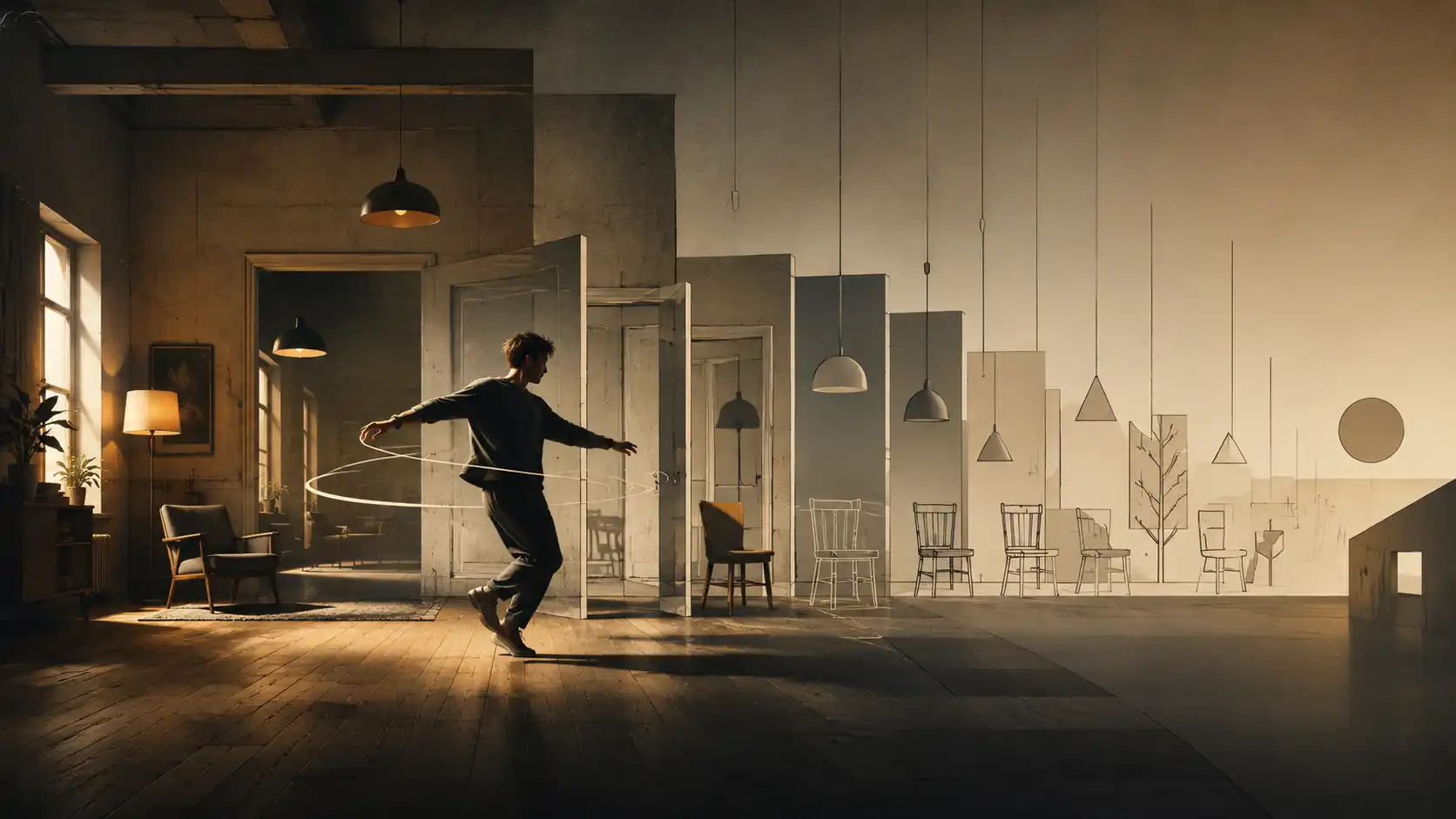
The technical term is invariant representation. The felt experience is simply: knowing. You recognise a chair whether it has four legs or one, whether it is wooden or plastic, whether you have seen that specific chair before or never. Your mind does not store every chair — it stores the idea of chair, abstract enough to contain all of them.
What You Are Actually Storing
Your memory is not an archive. It is not a hard drive, precise and literal and permanent. It is something far more interesting than that.
Every experience you have ever had — every room entered, every problem solved, every face recognised — has been processed by your mind not as a photograph but as a pattern. The specific details blur. The essential shape remains. And it is that shape, that abstraction, that your mind files away and draws from later.
This is why you can walk into a building you have never visited and still navigate it. Why you can read a sentence written by someone you have never met and understand it completely. Why you can meet a stranger and within moments begin to read them — their mood, their manner, their intent — without a single word exchanged.
You are not reasoning from facts. You are pattern-matching at speed so extraordinary it feels like intuition.
Because it is intuition. Intuition is just pattern recognition wearing quieter clothes.
The Price of Precision
There is a cost to storing the world this way.
Modern AI systems do generalise — that is, in fact, what machine learning is largely about. They compress statistical patterns from vast amounts of data, and in narrow domains they do it remarkably well. This is not nothing.
But there is a specific kind of generalisation they still struggle with. The kind that works from a handful of experiences, transfers freely across unrelated domains, and operates without needing to have seen a million examples first. The kind a child does effortlessly and a model does not.
Your mind trades precision for flexibility in a way that remains distinctive. It stores the approximate in order to reach the unprecedented. It sacrifices the pixel-perfect so that it can meet the never-before-seen and still find its footing.
This is not a flaw in human cognition. This is its genius.
Surprise Is the Teacher
Here is the thing about learning that most people have backwards.
We assume learning happens when things go smoothly. When we understand. When the information lands cleanly and we can tick the box. But that is not when your mind is actually growing. That is when it is coasting.
Your mind grows when something breaks its expectations.
When the world does something your patterns did not predict, your attention sharpens. Your mind cannot file this experience away under an existing label, so it saves it differently — at higher resolution, with more detail, more emotional charge. It is not ready to generalise yet. It is still watching, still gathering, still waiting for the pattern to reveal itself.
This is why your most vivid memories are almost never the ordinary days. They are the days something unexpected happened. The disruption. The surprise. The moment reality failed to match what you thought you knew.
Those moments are not interruptions to your learning. They are the learning itself.
Routine Is a Slow Forgetting
Consider what happens when nothing surprises you.
Day follows day. The same routes, the same faces, the same shape of hours. Your mind’s expectations are met, again and again, so smoothly that it barely needs to pay attention. And so it doesn’t. The specific details of each day dissolve almost as they happen. Thirty days pass and you can barely account for them.
This is not rest. This is not peace. Unchecked, this is your mind quietly narrowing.
The more your life matches what you already know, the less your mind is asked to grow. You become highly efficient within your existing patterns — and increasingly fragile outside them. The rut, from the inside, can feel like mastery. From the outside, it looks like a slow calcification of the possible.
Routine has its place. Stability is not the enemy. But routine should be the container, not the contents. The outer shell that holds the space for novelty — not the substance of the days themselves.
The Intelligence That Roams
Leonardo da Vinci did not become extraordinary by going wide instead of deep.
He went deep into many things. Obsessively deep. The breadth was not a substitute for mastery — it was mastery, multiplied across domains that had no obvious reason to speak to each other. And because they spoke to each other anyway, through him, something became possible that could not have emerged from any single field alone.
Because the patterns in one domain were always whispering to the patterns in another.
This is how cross-domain intelligence works. An insight from architecture reshapes how you think about a relationship. A principle from music reorganises how you approach a business problem. A metaphor from biology unlocks something that logic alone could not reach.
The mind that roams accumulates not just more patterns — but more connections between patterns. And it is the connections, more than the patterns themselves, that generate genuine insight.
Depth without breadth produces expertise. Breadth without depth produces dilettantism. The combination — rare, difficult, worth pursuing — produces the ability to see what others cannot.
What Spin Does
This is, at its core, what spinning is about.
Not the physical act alone — though that is where it begins, where the body learns something the mind then inherits. The spin becomes a laboratory for pattern recognition in real time. Every rotation is a negotiation between what you expect and what is actually happening. Between the shape you have stored and the specific moment unfolding.
To spin well, you must generalise. You must hold the pattern loosely enough that it can meet the variation. You must be surprised without losing your footing.
And then you must integrate that surprise — let it reshape the pattern slightly, improve the representation, carry the learning into the next rotation.
This is not a metaphor for intelligence. It is intelligence, made physical, made visible, made felt.
The Practice
So here is what this means, taken seriously:
Seek the experience your existing patterns cannot handle. Not recklessly — but deliberately. The book from a field you know nothing about. The conversation with someone who sees the world entirely differently. The problem you have been avoiding because you are not sure you know how to approach it.
Your discomfort in those moments is not a warning. It is the sound of new patterns forming.
Notice, too, the labels you have given to everything around you — to people, to situations, to yourself. Those labels are invariant representations. They are useful fictions that help you navigate. But they are not the truth. Reality is always richer, stranger, more specific than any label you have placed on it.
Question the labels. Especially the ones you placed on yourself a long time ago and have not examined since. Those old representations may have been accurate once. They may be holding you in a shape the story has already moved past.
More Intelligent Than Yesterday
Intelligence is not a fixed thing you were born with.
It is an ongoing process of forming better and better representations of an ever-changing world. Of generalising more accurately, connecting more creatively, adapting more gracefully when reality refuses to match your expectations.
Which means the question is never: how intelligent am I?
The question is: how intelligently am I living?
Are you giving your mind the new input it needs to keep growing? Are you letting surprise teach you? Are you questioning the patterns you have settled into — especially the comfortable ones, especially the ones that have been there so long you have forgotten they are patterns at all?
The mind that keeps spinning never stops learning.
And the mind that never stops learning is never truly stuck.
What pattern in your life has been trying to reveal itself to you? What unexpected thing, looked at long enough, might finally resolve into something you recognise?
This article is part of a larger system exploring how the mind actually works beneath conscious effort. Explore other ideas in this series — The Power of Stepping Back, The Freedom of Resolution, and Beyond Self-Discipline: Life by Design. If the mind’s default mode is to “spin,” then these articles describe how to guide that spin rather than fight it.